















We often hear the term “narcissist” used in everyday conversation. Usually, people are referring to egocentric or vain aspects of someone’s personality. But there is a deeper and more damaging pattern of behavior characterized by a general lack of empathy, a constant need for admiration, and an inflated sense of self-importance.
The clinical diagnosis of Narcissistic Personality Disorder (NPD) refers to a severe and complex mental health condition involving an unrealistically inflated sense of self and challenging interpersonal patterns that put one at odds with others [1].
There are two distinct but interrelated types of NPD: “grandiosity” and “vulnerability”. When they are combined, the term ‘pathological narcissism’ is frequently used. In this article, I outline 12 key traits of NPD to assist in understanding this complex condition and identify treatment approaches [2].
What Is a Narcissist?
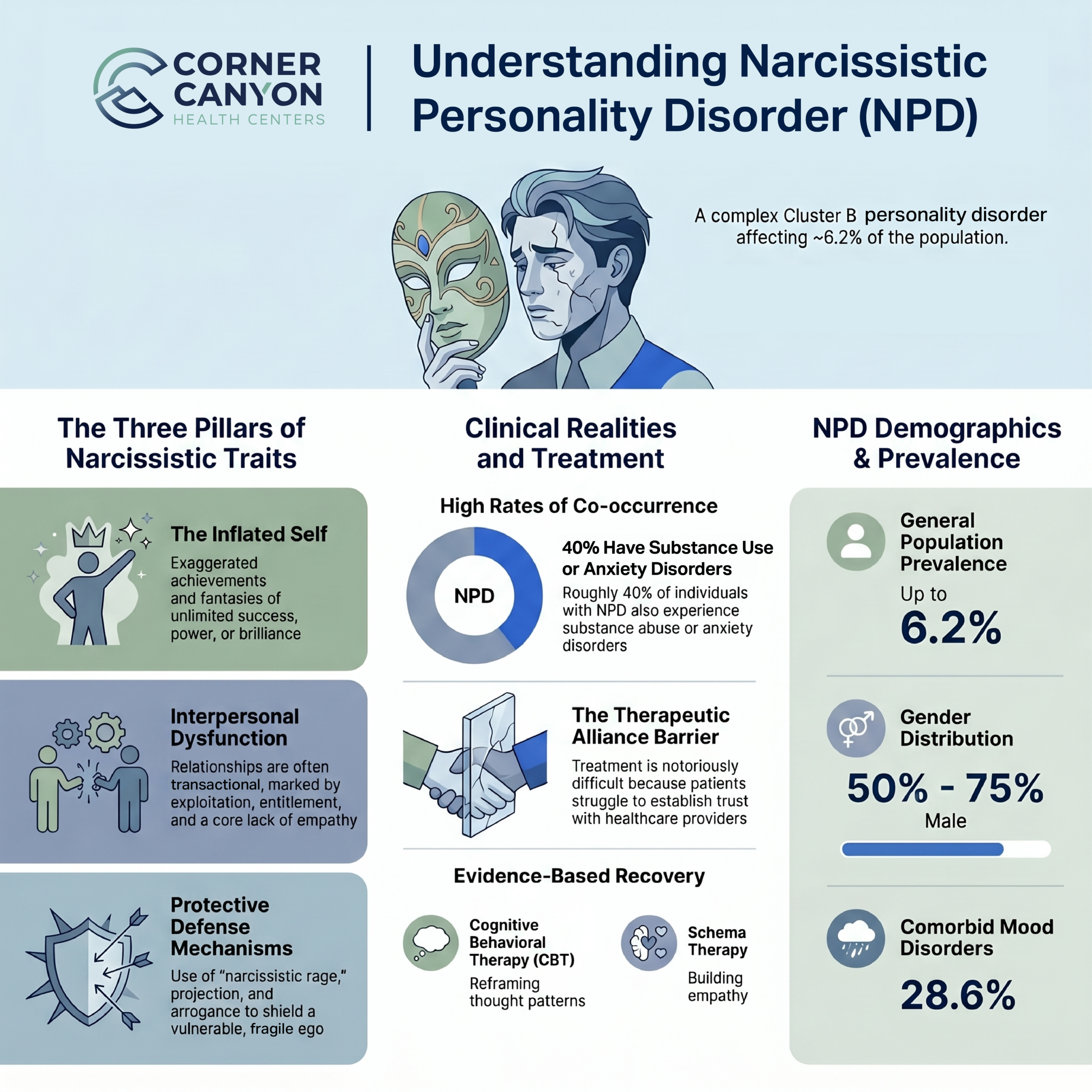
NPD affects up to 6.2% of the population, with 50%-75% being male. The DSM-5, the manual used by psychiatrists to diagnose, classifies NPD as a Cluster B (“dramatic, emotional, and erratic”) personality disorder, a category that also includes Antisocial, Borderline, and Histrionic Personality Disorders.
Among those with NPD, 40.6% have a substance abuse condition, 28.6% have mood disorders, and 40% have anxiety disorders. Suicidal ideation, cardiovascular, and gastrointestinal issues are prominent as well [1]. It is well-known as a difficult disorder to treat in therapy for a variety of reasons, primarily the inability of the patient to establish a productive therapeutic alliance.
What Are the Core Traits of Narcissistic Personality Disorder?
As a complex disorder, there are many aspects, not all of which may be apparent at first. Here are the core traits, with examples: [3] [4] [5].
Category 1: The Inflated Self (The Foundation of Grandiosity)
- Grandiose self-importance: Their own significance, achievements, and talents are exaggerated, often with boasting. Assumes they will be recognized as superior without achievements to match.
Example: Despite being a mid-level employee, they think they are the most critical person in the company.
- Preoccupation with fantasies of success, power, and brilliance: Fantasizes about unlimited success, influence, intelligence, or ideal love. An obsession with attainment and grandiosity beyond realistic bounds as reality often fails to meet these fantasies.
Example: Talks to everyone about a future best-selling novel they “are writing”, with no pages written.
- Belief in being “special” or “unique”: Thinks they can only be understood by, or should only associate with, other special or high-status people.
Example: Dismisses feedback from colleagues as that of “unqualified” people.
Category 2: How They Relate to Others
- Requires excessive admiration: Bottomless need for praise, attention, and validation from others to reinforce their fragile self-esteem.
Example: Becoming angry or sullen if a partner doesn’t compliment a new outfit or achievement.
- Sense of entitlement: Expects unreasonably to be treated favorably. Without earning it, demands automatic compliance to their expectations and feels angry if denied.
Example: Believes rules don’t apply to them.
- Exploits others: Achieves their goals by manipulating and using other people. Without regard for other’s feelings, relationships are transactional for personal gain. Does not respect personal boundaries and has intrusive or disrespectful behavior.
Example: Drops a friend after using them to get a job.
- Lack of empathy: This is a core trait of NPD. Is unwilling or unable to recognize or identify with others’ feelings and needs. Due to their self-centered and manipulative attitudes, struggles with authentic, sustained connections.
Example: Calls the grief a partner feels at the loss of a dear friend, “dramatic”.
Category 3: The Defense Mechanisms: Protecting the Fragile Ego
- Consumed by envy. Of others, and believes others are envious of them. Is often jealous and resentful of the success of others.
Example: Belittles a colleague’s promotion as “luck”.
- Arrogant behaviors or attitudes: Condescending, conceited, and patronizing. Dismissive of others’ achievements, looking down on them.
Example: In a condescending tone, belittles others.
- Fragile self-esteem: Beneath the grandiosity lies a fragile ego vulnerable to the slightest criticism.
Example: Takes minor feedback as a devastating personal attack.
- Narcissistic rage: Particularly when their self-image is threatened in response to a perceived slight, challenge, or criticism, they have mood swings and react dramatically with intense anger or passive-aggressive behavior.
Example: During and after a minor disagreement, screams, gives the silent treatment, or launches a smear campaign.
- Projection: Is a defense mechanism where they attribute their own unacceptable feelings, motivations, or behaviors to someone else.
Example: A cheating narcissist constantly accuses their partner of being unfaithful.
Awareness of NPD: Not Armchair Diagnosis
Having one or two of these traits does not mean someone is a narcissist. It is the pervasive, long-term pattern of these behaviors that defines NPD. The main paradox with NPD is that the external appearance of supreme confidence masks a profoundly vulnerable and fragile sense of self. All the other traits are defenses to protect this fragile ego.
These traits help in understanding the underlying motivations and potential challenges in interactions with narcissists. Recognizing these traits with compassion is important, as many individuals may display narcissistic tendencies without having full-blown NPD.
Treating Narcissistic Personality Disorder
Treatment of NPD is notoriously difficult. Symptoms frequently overlap with other Cluster B disorders, such as Histrionic Personality Disorder, Borderline Personality Disorder, and Antisocial Personality Disorder
Provider-patient relationships among individuals with NPD can be challenging due to interpersonal dysfunction marked by dramatic, emotional, and erratic thinking and/or behavior. Reasons for this include [1]:
- Superlative self-talk and self-aggrandizement
- Expectation of special treatment
- Poor behavioral health adherence
- Difficult relationships with health care providers
- Poor boundaries
- Ambivalence about change
- Cognitive distortions
- Help-rejecting behaviors
- Hypersensitivity and paranoia in therapy and in their everyday lives
Cognitive Behavioral Therapy (CBT) and Schema Therapy are recommended approaches to help reframe black-and-white thought patterns and develop greater empathy for others. Nonetheless, many patients do not continue treatment as their narcissistic wounds cannot tolerate the challenges of therapy.
 Personality Disorder Treatment in Utah County
Support for personality disorders—including narcissistic personality patterns—requires a thoughtful, highly individualized approach. At Corner Canyon Health Centers, we provide a judgment-free, stigma-aware environment where clients can safely explore long-standing patterns without shame or labels defining their identity.
Our clinicians understand that conditions like Narcissistic Personality Disorder (NPD), Borderline Personality Disorder, and other Cluster B presentations are often rooted in deep emotional wounds, attachment disruptions, and protective survival strategies. Rather than pathologizing these behaviors, we focus on building insight, emotional awareness, and healthier ways of relating to self and others.
Treatment may include Cognitive Behavioral Therapy (CBT), Dialectical Behavior Therapy (DBT), and schema-focused work to address core beliefs, improve emotional regulation, and strengthen interpersonal functioning. Our team is experienced in working with the complexities of narcissism and we prioritize creating a therapeutic alliance built on trust, respect, and consistency.
If you or a loved one is seeking treatment for a personality disorder or would like to be assessed, reach out to our admissions team to learn how compassionate, expert care can support real growth and healthier relationships.

Frequently Asked Questions
What is a narcissist?
A “narcissist” is a commonly used term to describe someone with traits associated with Narcissistic Personality Disorder (NPD). Clinically, NPD is a mental health condition involving a pattern of grandiosity, a need for admiration, and difficulty with empathy.
What are the characteristics of Narcissistic Personality Disorder?
Common characteristics of NPD include:
- Inflated sense of self-importance
- Preoccupation with success, power, or ideal love
- Need for excessive admiration
- Sense of entitlement
- Exploitative or manipulative behavior
- Lack of empathy
- Envy of others or belief that others envy them
- Arrogant or dismissive attitudes
- Fragile self-esteem beneath outward confidence
- Intense reactions to criticism (narcissistic rage)
These traits exist on a spectrum and vary in severity.
How do you know if you are a narcissist?
If you’re asking this question, it’s already a sign of self-reflection, which is often limited in more severe narcissistic patterns. You might consider seeking professional support if you notice:
- Ongoing difficulty maintaining healthy relationships
- Strong reactions to criticism or rejection
- A need for constant validation
- Patterns of conflict, control, or emotional distance
A licensed mental health professional can provide an accurate assessment and help you better understand your patterns without judgment.
Does a narcissist know they are a narcissist?
In many cases, individuals with narcissistic traits do not fully recognize their behavior as problematic. They may be aware of conflicts in relationships but often attribute issues to others rather than themselves.
However, some individuals—especially those in treatment—can develop insight over time. Building this awareness is a key goal in therapy.
Can narcissistic personality disorder be treated?
Yes. While NPD can be challenging to treat, meaningful progress is possible with consistent, specialized care. Therapy focuses on increasing self-awareness, improving emotional regulation, and building healthier interpersonal patterns.
What should I know before starting personality disorder treatment at Corner Canyon?
Treatment for personality disorders is a gradual, collaborative process that requires consistency and openness. At Corner Canyon, clients can expect:
- A supportive, respectful therapeutic environment
- Clear goals tailored to individual needs
- A focus on long-term growth, not quick fixes
- Clinicians experienced in complex relational and emotional patterns
We prioritize building a strong therapeutic alliance, which is essential for meaningful progress in treating personality-related challenges.
Sources
[1] Kacel, E. et al. (2017). Narcissistic Personality Disorder in Clinical Health Psychology Practice: Case Studies of Comorbid Psychological Distress and Life-Limiting Illness. Behavioral medicine (Washington, D.C.), 43(3), 156–164.
[2] Day, N. et al. (2025). Clinician Diagnostic Ratings and Countertransference Reactions Towards Grandiose and Vulnerable Narcissism. Clinical psychology & psychotherapy, 32(2)
[3] Leadership IQ. 2024. 12 Traits of a Narcissist Revealed: A Deep Dive into Their Minds.
[4] Adolescent Mental Health. 2024. 12 Traits of a Narcissist: Identifying Toxic Behavior.
[5] Schwab J. 2024. Spotting the Signs: Unveiling the 12 Traits of a Narcissist. juliaschwabtherapy.com