















LGBTQ+ people experience depression, anxiety, and suicidal thoughts at roughly two to three times the rate of their peers.
The research points to one main driver: minority stress, the chronic strain of moving through a world that is not always safe or accepting. But the data holds something hopeful too. Even one accepting person measurably lowers suicide risk.
Read on to see what the numbers actually show, why the gap exists, and where to find support in Utah and nationally.
How Common Are Mental Health Challenges in the LGBTQ+ Community?
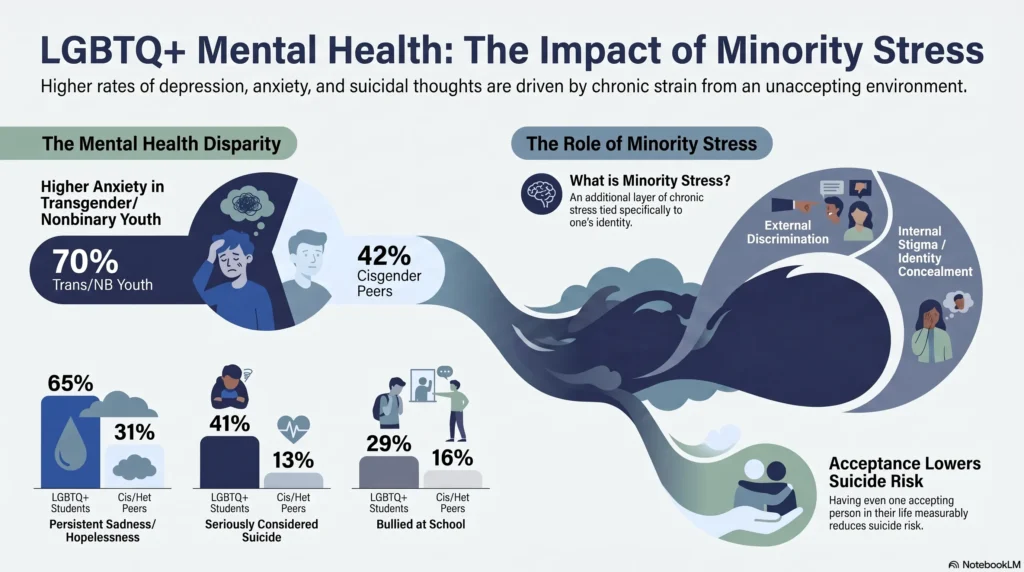
According to the CDC’s 2023 Youth Risk Behavior Survey, 65% of LGBTQ+ students reported persistent feelings of sadness or hopelessness, compared to 31% of their cisgender and heterosexual peers. LGBTQ+ students were also more likely to have seriously considered suicide, at 41% versus 13% [1].
Among young people nationally, a study of more than 16,000 LGBTQ+ young people found that transgender and nonbinary youth reported anxiety at nearly twice the rate of their cisgender peers, 70% compared to 42% [2].
These are not small gaps. They point to a group carrying a heavier mental health load than the general population, consistently across age groups and data sources. The CDC also found LGBTQ+ students were more likely to report being bullied at school, at 29% compared to 16% of their peers, which helps explain part of where that heavier load comes from [1].
Why Do LGBTQ+ People Face Higher Rates of Depression and Anxiety?
The leading explanation in the research is minority stress, the idea that LGBTQ+ people carry an additional layer of chronic stress tied specifically to their identity, on top of the ordinary stress everyone experiences.
That stress comes from two directions: external experiences such as discrimination, harassment, or family rejection, and internal experiences such as concealing one’s identity or absorbing stigma over time.
Research has consistently linked both forms of minority stress to higher rates of psychological distress, depression, and substance use [3]. It is not that being LGBTQ+ causes poor mental health. It is that moving through a world that is not always safe or accepting takes a real, measurable toll, one that shows up in the body as well as the mind over time.
What Does the Data Show About LGBTQ+ Suicide Risk?
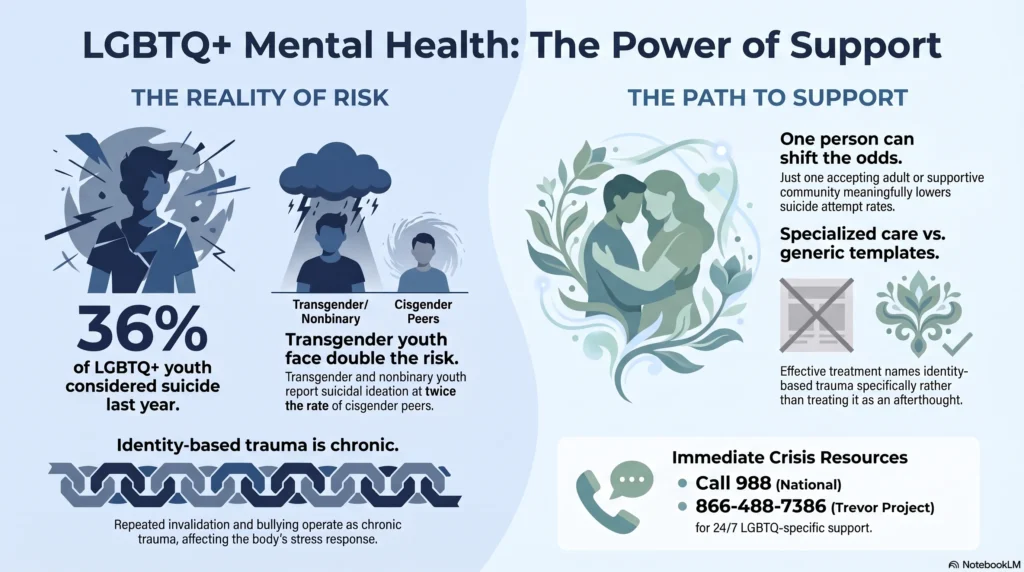
Suicide risk is where the disparity becomes most urgent. One major survey found that 36% of LGBTQ+ young people considered suicide in the past year, and transgender and nonbinary youth reported suicidal ideation at nearly twice the rate of their cisgender peers [2].
Young people in the LGBTQ community who have even one accepting adult or a supportive community see meaningfully lower rates of suicide attempts, which is precisely why connection and access to care matter so much [2].
That single finding is one of the more hopeful data points in this entire body of research: support measurably changes outcomes, and it does not take an entire community to provide it; sometimes just one person is enough to shift the odds.
How Does Trauma Affect LGBTQ+ Mental Health?
LGBTQ+ people report experiences such as bullying, family rejection, and violence at higher rates than their peers, and research on minority stress describes how repeated identity-based invalidation can operate as its own form of chronic trauma, affecting emotional regulation and the body’s stress response over time [3].
This is part of why generic mental health care does not always land the way it should. Trauma tied to identity often needs to be named and understood specifically, not treated as an afterthought within a broader diagnosis, and clinicians who are not familiar with LGBTQ+ experiences can miss it entirely even when they mean well. Trauma-focused treatment that accounts for identity can make that difference.
Where Can You Get Help in Utah and Nationally?
Call or text 988 if you are in immediate crisis, which is the national Suicide and Crisis Lifeline, available 24/7 to anyone, including LGBTQ+ callers, and can connect you with additional resources [4].
The Trevor Project also operates a crisis line specifically for LGBTQ+ young people, reachable by calling or texting 866-488-7386 at any hour [5].
The Utah Pride Center in Salt Lake City offers mental health services on a sliding scale, peer support groups, and community resources for LGBTQ+ individuals and families and can be reached at 801-539-8800 [6].
How Does Corner Canyon Support the LGBTQ+ Community?
Corner Canyon Health Centers was built with a clear understanding that LGBTQ+ clients need more than a facility that says it is accepting. Staff are trained specifically in LGBTQ+ identity, culture, and the particular ways trauma and minority stress show up in this community so that care does not require a client to first explain or defend who they are.
Whether someone is dealing with depression, anxiety, trauma, or a combination that has built up over years, treatment is designed around the person, not a generic template. Specialized care can make a significant difference for LGBTQ+ individuals and for the parents and loved ones who are trying to support them, distinguishing between care that helps and care that adds another place to feel unseen. Explore our mental health programs or contact our admissions team today.
The data is real, and so is the path through it. Understanding the numbers is not the end of the story. It is the beginning of knowing what kind of support to look for and where to find it. Contact our admissions team today to receive the care you deserve.
Sources
[1] Centers for Disease Control and Prevention. Health Disparities Among LGBTQ Youth.
[2] The Trevor Project. 2025 U.S. National Survey on the Mental Health of LGBTQ+ Young People.
[3] Rikhotso, R. S. (2021). Mental health challenges of lesbian, gay, bisexual and transgender people: An integrated literature review. Health SA = SA Gesondheid, 26, 1487.
[4] 988 Suicide and Crisis Lifeline. LGBTQI+.
[5] The Trevor Project. Crisis Services.
[6] Utah Pride Center. Resources.