















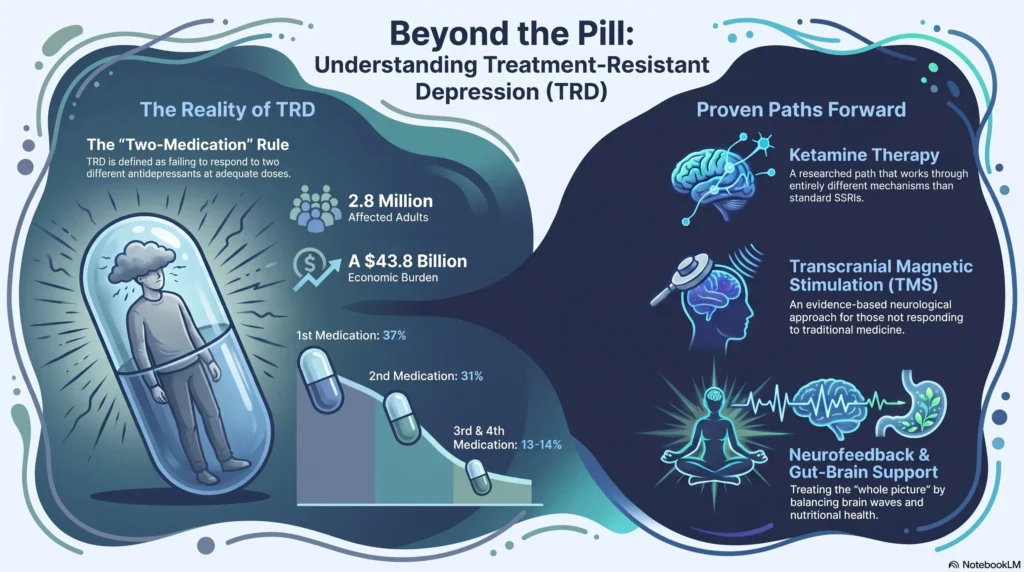
Treatment-resistant depression means someone has tried at least two different antidepressants at an adequate dose and duration without real improvement. It’s far more common than most people realize, affecting an estimated 2.8 million adults in the U.S. and nearly a third of everyone diagnosed with major depressive disorder.
The good news is that “resistant to medication” doesn’t mean “resistant to treatment.” Ketamine therapy, neurofeedback, and TMS all offer real, researched paths forward. Corner Canyon builds its own approach around ketamine and neurofeedback, paired with nutritional and gut-brain support, to treat the whole picture.
What Is Treatment-Resistant Depression?
Treatment-resistant depression, often shortened to TRD, has a specific clinical definition. The FDA defines it as major depressive disorder that hasn’t responded to at least two different antidepressants, taken at adequate doses for an adequate length of time, within the same depressive episode [1].
This isn’t about a medication that didn’t work after two weeks or one that caused side effects before it had a real chance. It’s about trying legitimate courses of treatment, often for months at a time, and still not feeling meaningfully better. TRD also isn’t the same as depression that’s simply severe. Someone can have mild symptoms that still don’t respond to medication or serious symptoms that respond fairly well.
What defines TRD is the gap between the treatment given and the improvement received, not the intensity of the depression itself.
How Many People Actually Have Treatment-Resistant Depression?
TRD is estimated to affect around 2.8 million adults in the U.S., close to one-third of everyone diagnosed with major depressive disorder. It carries a national economic burden of roughly $43.8 billion a year in healthcare costs and lost productivity [1].
The largest real-world study of depression treatment conducted in the U.S. found that in the first round of treatment, using a standard antidepressant, about 37% of patients reached remission. In the second round, after switching or adding medications, that number dropped to roughly 31%. By the third and fourth rounds, remission rates fell to around 14% and 13% [2].
Basically, the more medications someone has already tried without success, the lower the odds that the next one alone will be the answer. That’s not a personal failing. It’s a well-documented pattern that has pushed research toward treatments that work through entirely different mechanisms than standard antidepressants such as SSRIs (selective serotonin reuptake inhibitors) or SNRIs (serotonin and norepinephrine reuptake Inhibitors).
What Are Your Options When Medication Isn’t Enough?
This is where treatment for TRD starts to look different from a standard depression plan. Instead of cycling through another SSRI or SNRI, the most researched next steps work through entirely different pathways: ketamine therapy, transcranial magnetic stimulation (TMS), and neurofeedback.
None of these are last resorts. Each has a real evidence base, and each works differently, which is precisely why they matter for people who haven’t responded to medications that all work roughly the same way.
What Is Ketamine Therapy for Treatment-Resistant Depression?
Ketamine works nothing like a typical antidepressant. Rather than gradually adjusting serotonin levels over weeks, ketamine targets NMDA receptors tied to the neurotransmitter glutamate, which helps repair neural connections weakened by depression [3].
This is part of why ketamine can produce noticeable mood improvements within hours to days rather than weeks. An intranasal form called esketamine (Spravato) is FDA-approved specifically for TRD, for adults who have tried at least two antidepressants without adequate relief, as well as for major depressive disorder with acute suicidal ideation [3].
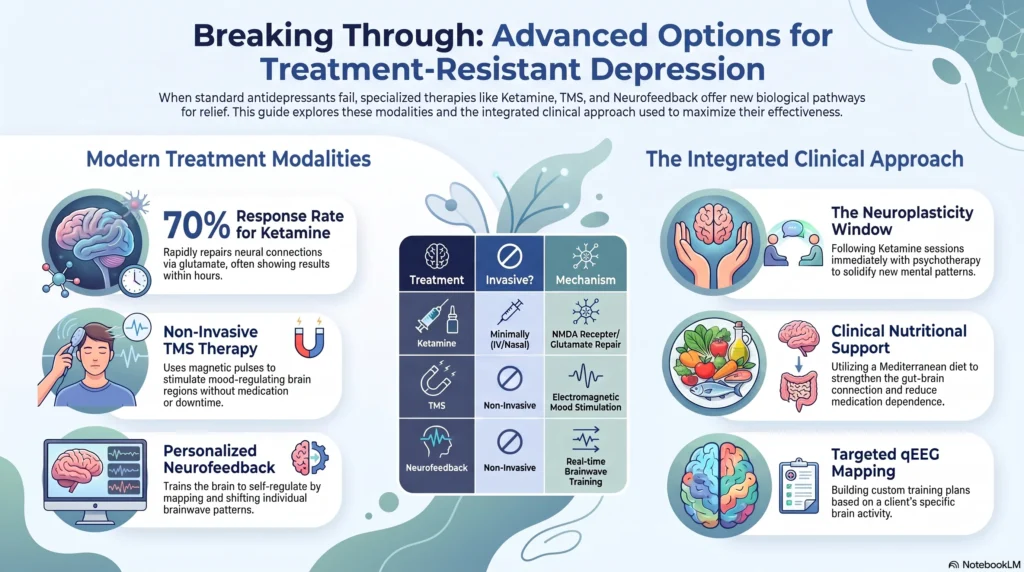
Off-label IV or intramuscular ketamine, administered in a monitored clinical setting, has shown short-term response rates around 70%, making it one of the more effective options currently available for TRD [3]. It isn’t a standalone cure. Effects from a single dose typically last only days, which is why ketamine is delivered as a structured series of sessions alongside psychotherapy, using the window of increased neuroplasticity to make other therapeutic work land more effectively.
What Is TMS Therapy for Depression?
Transcranial magnetic stimulation, or TMS, has been FDA-approved for depression since 2008 and is typically used specifically when standard treatments like medication and psychotherapy haven’t worked [4].
Unlike ketamine, TMS is entirely non-invasive and drug-free. An electromagnetic coil placed against the scalp delivers magnetic pulses that stimulate the region of the brain involved in mood regulation, an area that tends to show decreased activity in people with depression [4].
A typical course involves daily sessions, five days a week, for four to six weeks, with each session lasting anywhere from a few minutes to around 20 minutes depending on the stimulation pattern used. There’s no anesthesia and no recovery time. Most people return to normal activities immediately after each session.
Because TMS works through an entirely different biological pathway than antidepressant medication, it can help people who haven’t responded to pharmaceutical approaches without adding another medication into the mix.
Can Neurofeedback Help with Depression?
Neurofeedback trains the brain to regulate itself. Using a quantitative EEG, clinicians map an individual’s brainwave activity and identify patterns associated with depression, then use real-time visual or auditory feedback to help the person learn to shift those patterns.
Current research classifies neurofeedback protocols for depression as “possibly efficacious,” meaning there’s a real and growing evidence base, even as researchers continue refining exactly which protocols work best for which patients [5].
What makes neurofeedback appealing for TRD specifically is that it’s non-invasive, medication-free, and personalized to each person’s actual brain activity rather than a one-size-fits-all protocol. It’s rarely used alone, but as part of a broader treatment plan. It gives both clients and clinicians real-time information about what’s happening in the brain and whether current treatment is actually working.
How Does Corner Canyon Treat Treatment-Resistant Depression?
At Corner Canyon, treatment-resistant depression isn’t approached as a single problem with a single fix. Clients who are medically and clinically approved can receive a 6-week course of ketamine, administered in a private, medically supervised setting, followed immediately by a therapy session that puts the brain’s temporary window of neuroplasticity to work.
Neurofeedback is also part of the clinical model, using a qEEG brain map to build a training plan specific to each client’s own brainwave patterns rather than a generic protocol.
Alongside these approaches, Corner Canyon treats nutrition as a real clinical tool, not an afterthought. Meals are built around a Mediterranean diet, prepared by trained chefs, because supporting that gut-brain connection through real food, rather than processed ingredients, is treated as a legitimate part of reducing dependence on medication alone.
If antidepressants haven’t worked for you or someone you love, treatment-resistant doesn’t mean untreatable. Reach out to Corner Canyon’s admissions team to talk through whether ketamine therapy, neurofeedback, or a combined approach makes sense for your situation.

Sources
[1] Sambamoorthi, U. (2021). Economic Burden of Treatment-Resistant Depression among Adults with Chronic Non-Cancer Pain Conditions and Major Depressive Disorder in the US. PharmacoEconomics, 39(6), 639–651.
[2] Rush, A.J. et al. Acute and Longer-Term Outcomes in Depressed Outpatients Requiring One or Several Treatment Steps: A STAR*D Report. American Journal of Psychiatry.
[3] Nutt, D. et al. (2021). Ketamine for the treatment of mental health and substance use disorders: comprehensive systematic review. BJPsych open, 8(1), e19.
[4] Mayo Clinic. Transcranial Magnetic Stimulation.
[5] Melnikov, M.Y. The Current Evidence Levels for Biofeedback and Neurofeedback Interventions in Treating Depression: A Narrative Review. Neural Plasticity.