















Recovery from complex PTSD rarely looks like a single breakthrough session where everything clicks into place. Recovery usually means building the emotional regulation, sense of self, and safe relationships that repeated childhood or relational trauma never let you develop the first time.
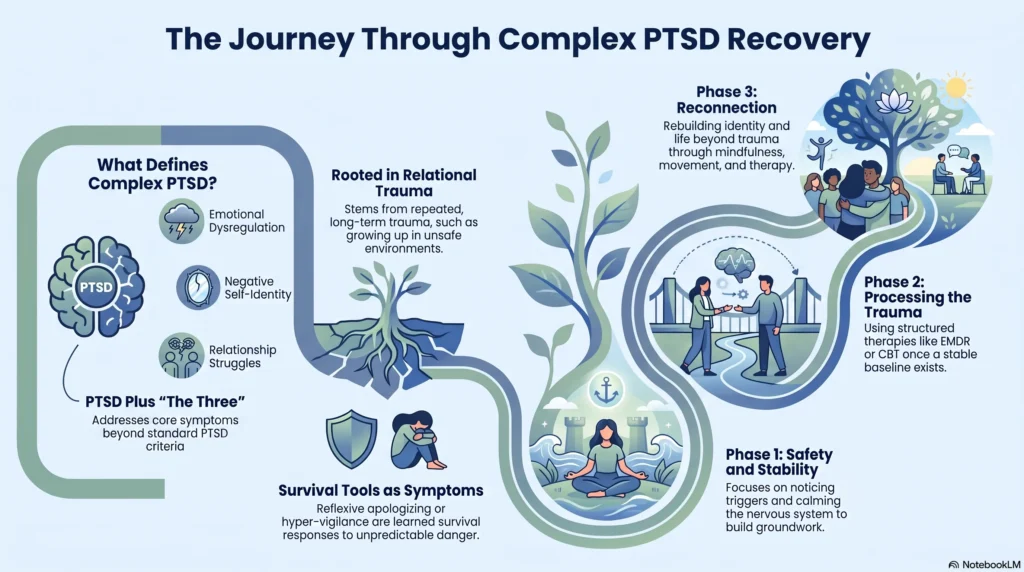
It tends to unfold in phases: 1. establishing safety and stability; 2. Then processing the trauma; 3. Then rebuilding a life beyond it, often with body-based work like mindfulness and movement alongside therapy.
What Makes Complex PTSD Different From PTSD?
Complex PTSD, now recognized as its own diagnosis, includes everything found in standard PTSD such as flashbacks, avoidance, and a constant sense of threat, plus three additional struggles: trouble regulating emotion, a persistently negative sense of self, and difficulty forming or trusting relationships [1].
These three additions usually trace back to trauma that was repeated and relational rather than a single, isolated event. This includes things like growing up with a parent whose love depended on your mood that day, or spending years in a home where safety was never guaranteed.
A person with standard PTSD might struggle around a specific trigger. A person with complex PTSD often struggles with a baseline sense that they are too much, not enough, or fundamentally unsafe in their relationships [1].
Think of someone who apologizes reflexively the moment a friend goes quiet, certain that silence means they have already done something wrong. That reaction did not come from nowhere. It came from years of learning that quiet in a house could turn dangerous without warning.
Does Standard Trauma Treatment Work for Complex PTSD?
Therapies like Eye Movement Desensitization and Reprocessing (EMDR), exposure work, and trauma-focused CBT effectively treat complex PTSD. The difference is timing: they usually work best when they are delivered in a phased approach.
These therapies were largely built and tested on single-incident trauma, and they ask a person to revisit a difficult memory fairly directly. That works well when someone has a stable baseline to return to afterward. Complex PTSD often does not start with that baseline. If dissociating or shutting down has been your main survival tool since childhood, going straight into memory processing can overwhelm a nervous system that was never taught how to regulate.
That is why effective care for complex PTSD is usually phased. The same proven therapies are still central to recovery, but they come after a period of building safety and stability first, so that when you do process the trauma, your nervous system has somewhere steady to return to [2].
What Does Effective Treatment for Complex PTSD Look Like?
Many clinicians build care for complex trauma around three phases: establishing safety and stability, processing the trauma itself, and reconnecting with a life and identity beyond it [3].
In practice, that first phase might mean learning to notice when you are spiraling before you are fully in it, building a felt sense that your body can come back to calm, and starting to trust a therapist enough to be honest about what is actually happening in your head.
Only after that groundwork holds does trauma processing begin, often through structured approaches that pair skills training with the same tools used for standard PTSD [3]. The point is not that one method is universally correct. It is that treatment should be built around what your specific nervous system can actually tolerate right now, not a one-size-fits-all plan.
Where Does the Body Fit Into All of This?
Complex trauma does not just live in memory. It lives in the body, in a nervous system that has learned to stay braced for danger long after the danger has passed [4]. This is why real recovery rarely stays purely clinical.
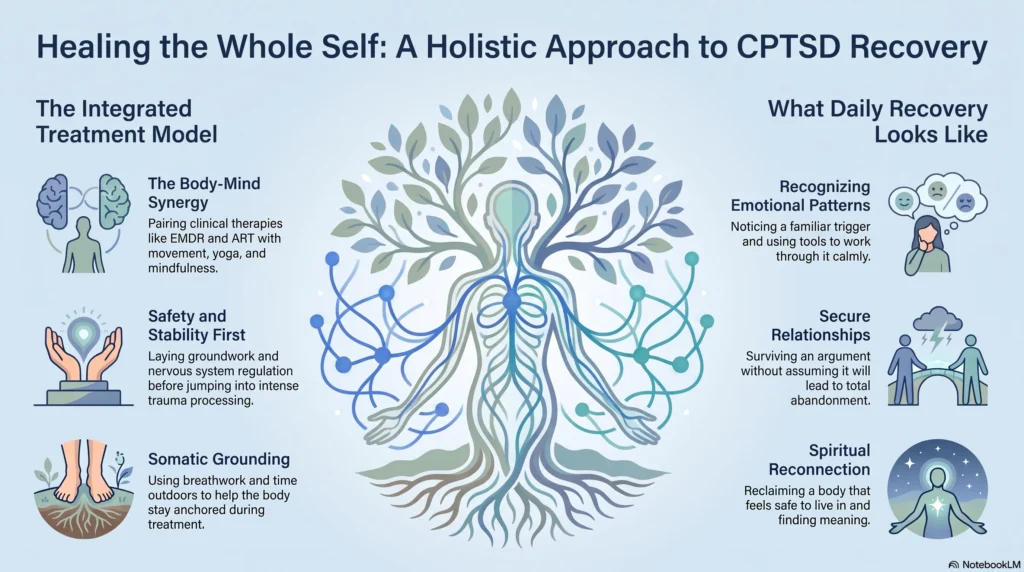
Mindfulness techniques, breathwork, yoga, and time spent outdoors are not add-ons to real treatment. They are often what makes real treatment possible in the first place, giving your body the tools it needs to stay grounded.
This often looks like pairing trauma-focused therapies such as EMDR, Accelerated Resolution Therapy (ART), and trauma-focused cognitive behavioral therapy (TF-CBT) with grounding practices, mindfulness, and dance or movement so the nervous system and the mind are being treated together rather than separately.
For many people, spiritual healing also plays a role, not necessarily in a religious nature but a genuine reconnection to meaning, to a body that feels safe to live in again, and to a sense that their story is not finished being written [4].
What Does Recovery Actually Look Like Day to Day?
Recovery from complex PTSD is usually not the disappearance of every symptom forever. It is more often the ability to notice a familiar pattern and have the tools to work through it.
It is a friendship that survives an argument because you no longer assume it means abandonment. It is being able to sit in silence with someone you trust without your body treating it as a threat. It is catching yourself mid-apology for something you did not actually do and choosing to stop.
Complex PTSD is usually a long-term condition, not something with a quick fix. However, with real treatment and an ongoing support system, people can learn to manage it and build a genuinely stable life.
Holistic Mental Health Treatment for Complex PTSD in Utah
Complex PTSD is not standard PTSD with a few extra symptoms. It asks for a different pace, a different order of operations, and a team that understands why jumping straight into trauma processing can backfire when the groundwork was never laid. At Corner Canyon in Draper, Utah, that understanding shapes everything we do.
We build treatment around where your nervous system actually is right now, not a fixed protocol. That means starting with safety and stability, pairing trauma-focused therapies like EMDR and Accelerated Resolution Therapy with mindfulness, movement, and nervous system regulation, and moving at a pace your body can tolerate rather than one that overwhelms it.
You spent a long time adapting to something that was never your fault. You are allowed to spend this time healing from it. Reach out to our team for a free, confidential conversation. We will answer your questions honestly, including whether we are the right fit for you.

Sources
[1] National Center for PTSD, U.S. Department of Veterans Affairs. Complex PTSD.
[2] Wright, A. 2026. Is EMDR Effective for CPTSD or Just Single-Incident Trauma? A Trauma Therapist’s Complete Answer. Anne Wright.
[3] National Center for PTSD, U.S. Department of Veterans Affairs. Assessment of Complex PTSD.
[4] van der Kolk, B. (2014). The Body Keeps the Score: Brain, Mind, and Body in the Healing of Trauma. Penguin Books.