
















Bipolar I and bipolar II are two forms of bipolar disorder. Both cause big shifts in mood and energy. The main difference is the high phase. Bipolar I brings full mania. Bipolar II brings milder hypomania with heavy depression. Knowing your type helps your care team choose the right treatment.
What Bipolar Disorder Means
Bipolar disorder is a mental health condition. It causes clear shifts in mood, energy, and activity [1]. People move between two main states. One is an emotional high. The other is depression, a deep low. Between episodes, many people feel stable. How high the high goes separates bipolar I from bipolar II.
Bipolar I Disorder
Bipolar I involves at least one manic episode. Mania is an intense high. It lasts at least 7 days, or it is severe enough to need a hospital stay [2]. During mania, a person may feel powerful, sleep very little, and act on risky urges. Some people also have hallucinations or delusions, known as psychosis [1]. Most people with bipolar I also have depressive episodes. But only one manic episode is needed for the diagnosis.
Bipolar II Disorder
Bipolar II involves hypomania and major depression. Hypomania is a milder high. It lasts at least 4 days [2]. The person still functions and rarely needs a hospital. Because of these factors, hypomania is easy to miss. The depression in bipolar II is often long and heavy [3]. Many people with bipolar II spend far more time depressed than high. A person with bipolar II never has a full manic episode. If they do, the diagnosis becomes bipolar I.
The Key Differences Side by Side
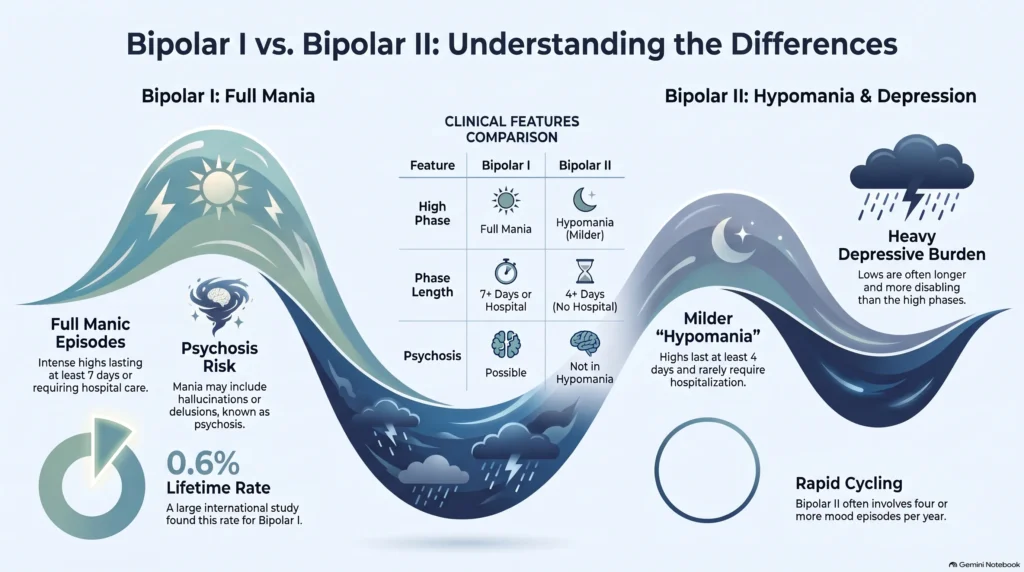
The table below shows how the two types compare.
| Feature | Bipolar I | Bipolar II |
|---|---|---|
| High phase | Full mania | Hypomania, milder |
| High phase length | 7+ days or hospital | 4+ days, no hospital |
| Psychosis | Possible | Not in hypomania |
| Main burden | Mania and depression | Mostly depression |
Research shows people with bipolar II often have more depressive episodes and more rapid cycling, which means four or more mood episodes in one year [4].
How Common Is Each Type
Bipolar disorder affects people around the world. A large international study found a lifetime rate of about 0.6% for bipolar I and 0.4% for bipolar II [5]. Both types are serious. Both deserve full care.
Why the Difference Matters for Treatment
The two types share many treatments, but the focus differs. Care often combines medicine and talk therapy [3]. Mood stabilizers such as lithium help steady moods. Some people also take atypical antipsychotics [2].
Cognitive Behavioral Therapy helps people spot triggers and manage stress [2]. Because bipolar II brings more depression, treatment often gives extra attention to the low phase. A correct diagnosis helps your clinical team match the plan to your needs.
What Is the Main Difference Between Bipolar I and II?
Bipolar I includes full mania that may need hospital care. Bipolar II includes milder hypomania plus major depression, and never a full manic episode [2].
Is Bipolar II Less Serious Than Bipolar I?
No. Bipolar II is not a lighter version. Its long depressive episodes can be disabling and raise health risks. It needs full treatment [3].
Can Bipolar II Turn Into Bipolar I?
The diagnosis changes to bipolar I only if a person ever has a full manic episode. Regular check-ins help your clinical team track any change [2].
Key Takeaways
- Bipolar I and bipolar II both cause mood shifts, but the high phase sets them apart.
- Bipolar I brings full mania. Bipolar II brings milder hypomania and heavy depression.
- Getting the right diagnosis leads to the right treatment plan.
If you or someone you love shows these signs, reach out to a provider. Steady recovery is within reach.
Trauma-focused Treatment in Salt Lake County
Treatment for mental health conditions and trauma is available in Utah in a peaceful setting bordered by the beautiful Wasatch Mountains. Are you or a loved one looking for a compassionate space to heal from OCD, anxiety, trauma, PTSD, C-PTSD, other mental health conditions, or addictions?
Our licensed trauma-informed therapists and counselors at Corner Canyon Health Centers provide knowledgeable, empathic help using a range of therapeutic and holistic techniques. We also offer ketamine-assisted psychotherapy for treatment-resistant depression.
Reach out to our admissions team at Corner Canyon now.

Sources
| [1] | National Institute of Mental Health. (2024). Bipolar disorder. U.S. Department of Health and Human Services. |
| [2] | Jain, A., & Mitra, P. (2023). Bipolar disorder. StatPearls Publishing. |
| [3] | MedlinePlus. (2024). Bipolar disorder. National Library of Medicine. |
| [4] | Brancati, G. E., et al. (2023). Differential characteristics of bipolar I and II disorders: A retrospective, cross-sectional evaluation of clinical features, illness course, and response to treatment. International Journal of Bipolar Disorders. |
| [5] | Merikangas, K. R., et al. (2011). Prevalence and correlates of bipolar spectrum disorder in the World Mental Health Survey Initiative. Archives of General Psychiatry. |