















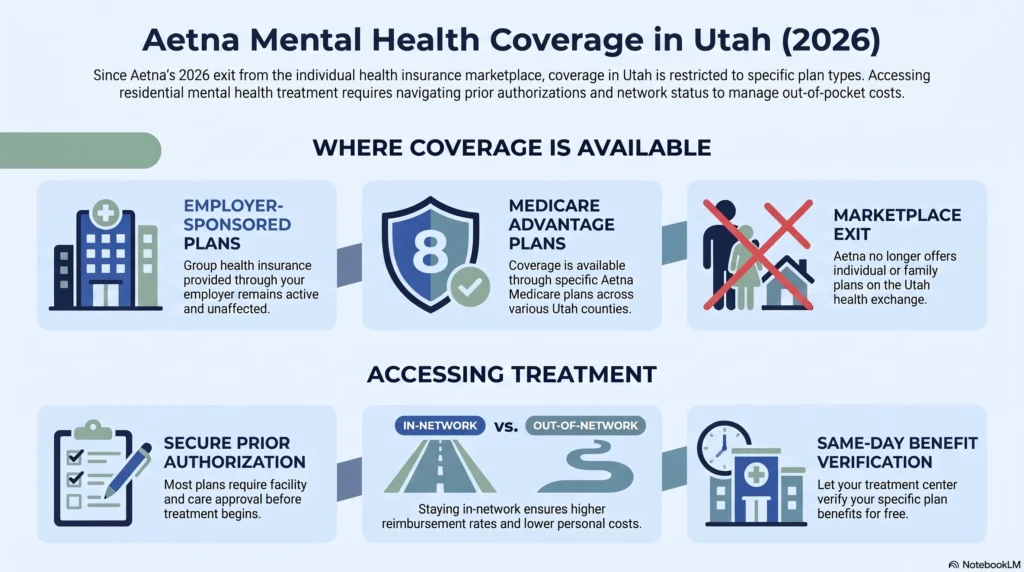
Aetna can cover residential mental health treatment, but it depends on your plan. Aetna exited the individual marketplace nationwide in 2026, so Utah residents with Aetna now have it through an employer or a Medicare Advantage plan.
Coverage levels vary significantly between those plan types, and most require prior authorization before residential treatment begins. This means the facility and level of care must be approved before you arrive.
Whether Aetna covers the full cost depends largely on whether the treatment center is in-network. Out-of-network care is sometimes still covered, but typically at a lower reimbursement rate and with a higher out-of-pocket responsibility. If there is a remaining balance after insurance pays, options like payment plans and partial reimbursement can help cover the gap [1].
The fastest way to know exactly what your plan covers is to let the treatment center verify your benefits directly. Most do this at no cost, usually within the same day.
What Is Aetna?
Aetna is one of the largest health insurance companies in the United States, operating as a subsidiary of CVS Health. They offer a broad range of coverage types, including employer-sponsored plans, Medicare plans, and dental and vision coverage [1].
What your plan actually covers depends on several things, including the state you live in and the specific plan you or your employer selected. That is why two people can both have Aetna but have meaningfully different coverage for the exact same type of care. Verifying your individual benefits is always the most reliable first step.
What Aetna Plans Are Available in Utah?
As of 2026, Aetna no longer offers individual or family health plans across 17 states after exiting the Health Insurance Marketplace [2][3]. In Utah specifically, Aetna now operates through two channels:
Employer-sponsored plans: If your job offers Aetna as a group health insurance option, that coverage remains active and unaffected by the marketplace exit.
Medicare Advantage plans: Aetna offers eight Medicare Advantage plans across parts of Utah for 2026, with availability varying by county.
If you currently have an individual Aetna plan that was active before 2026, you will have been notified by Aetna to select a new carrier during open enrollment. If you are unsure of your current coverage status, contact Aetna directly, or check healthcare.gov for the fastest way to clarify.
Does Aetna Cover Residential Mental Health Treatment?
In most cases, yes. Aetna plans usually cover residential mental health treatment. This is one of several levels of behavioral health care Aetna offers. Others include therapy, outpatient programs, and partial hospitalization [1].
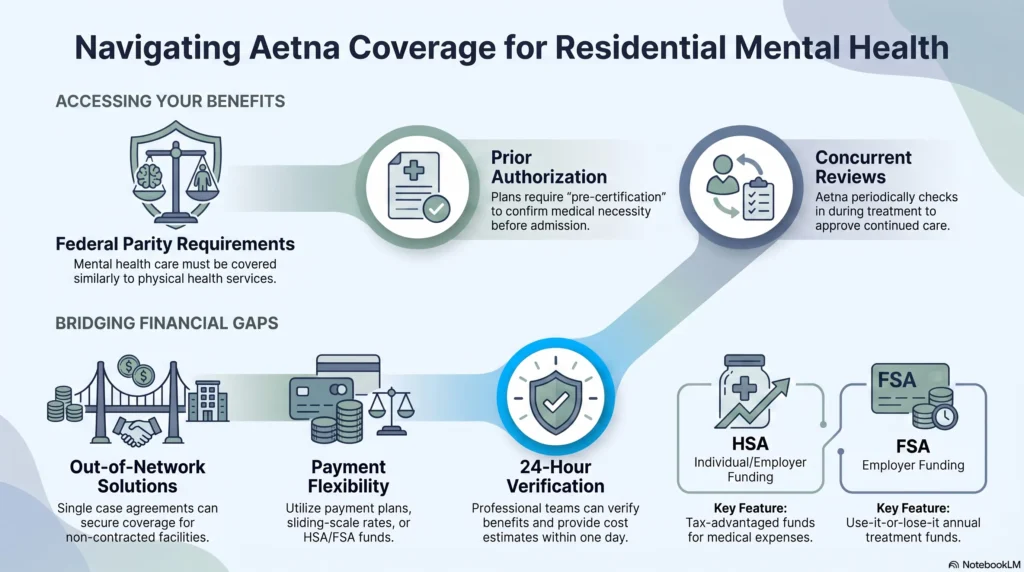
Part of federal law says most insurance plans must cover mental health care the same way they cover physical health care. So if your plan covers a hospital stay for a broken leg, it usually has to offer similar coverage for a mental health crisis.
This does not mean every stay gets approved right away, but it does mean residential treatment is a real, covered benefit on most Aetna plans.
What Can You Expect From Aetna Before and During Treatment?
Before residential treatment starts, most Aetna plans require prior authorization. This is also called pre-certification [4]. It means the treatment center must contact Aetna first and explain why residential care is medically necessary. Then Aetna gives approval before you are admitted.
Once you are in treatment, Aetna often checks in with the treatment center to confirm that continued care is still needed.
What If Aetna Doesn’t Cover Your Treatment?
If a treatment center is out-of-network, you still have options. So does anyone whose plan covers less than they hoped. Many facilities can ask for a single case agreement, which means asking Aetna to pay an agreed rate for your specific treatment, even without a full contract.
If insurance does not cover the full cost of care, there are several other ways to make treatment financially accessible:
- Payment plans: The treatment center breaks your out-of-pocket costs into monthly installments rather than requiring full payment upfront, making care more manageable on a budget.
- Sliding-scale rates: Your fee is adjusted based on your household income, so people with lower incomes pay less for the same level of care.
- HSA (Health Savings Account): A tax-advantaged account you fund through your employer or independently, which can be used to pay for qualified medical and mental health expenses, including treatment.
- FSA (Flexible Spending Account): Similar to an HSA but typically employer-funded and use-it-or-lose-it annually, also accepted for qualifying treatment costs.
The best move is to ask Aetna or the treatment center what your real cost will likely be. That way there are no surprises once treatment starts.
How Does Corner Canyon Help With Aetna Coverage?
At Corner Canyon, the first step is usually a free Verification of Benefits, or VOB. Our admissions team sends this directly to your insurance and we usually get answers back within 24 hours.
This tells us what your Aetna plan covers for residential mental health treatment. It also gives you a real cost estimate before you commit to anything. If your plan is not in-network with us, our team can look into a single-case agreement for you and help you explore other payment options.
We do not accept Medicare or Medicaid, but for private Aetna plans, our admissions team walks you through every step. You will not have to figure out insurance paperwork alone. If you are ready to find out what your Aetna plan actually covers, reach out to our admissions team today.

Sources
[1] Aetna. (n.d.). Behavioral health programs & plans. Aetna.
[2] Aetna. (n.d.). Precertification: Health care professionals. Aetna.
[3] Min, P., & Coleman, E. (2025). Aetna drops out of ACA exchange in 2026: Here’s how it could affect you. Forbes Advisor.
[4] Healthinsurance.org. (2025). Utah health insurance marketplace: 2026 ACA coverage guide. Healthinsurance.org.