













⚠️ We Do Not Accept Medicare or Medicaid 

Why Complex PTSD Disrupts Sleep (And What Actually Helps)

Sara Sorenson, LCMHC

Clinical Director

Sara grew up in the US, then Germany and the UK, returning to the United States to attend university. Since then, she has lived in Maryland, Hawaii, Australia, and Utah, and enjoyed visiting many beautiful places in between. Sara has a genuine interest in people and truly enjoys making connections wherever she can. She is constantly looking for new things to learn and areas to improve in both her personal and professional life and appreciates the challenges that contribute to progress. She is drawn to adventure in all it’s forms, particularly in nature, travel and creative expression. Often, her most significant source of joy comes from spending time with her close friends and her four children.

Sara received a Bachelor’s degree in Sociocultural Anthropology and a Master’s in Rehabilitation Counseling. She is certified as a rehabilitation counselor (CRC) and a licensed Clinical Mental Health Counselor (LCMHC). Sara’s counseling experience includes working with individuals from a wide range of ages, backgrounds and mental health symptoms and disorders. Sara has worked extensively with foster children, sexual abuse victims and people with addictions.

Sara is trained and certified as an EMDR therapist and is passionate about facilitating the level of healing and insight that can be uniquely achieved with this approach. She also has experience with Cognitive Behavioral Therapy (CBT), Trauma-Focused Cognitive Behavioral Therapy (TF-CBT), Dialectical Behavioral Therapy (DBT), Acceptance and Commitment Therapy (ACT) and Art Therapy. She finds it most effective to address individual needs and preferences with the creative integration of theory and application, with a focus on helping a client identify and move towards their unique meaning and purpose. She enjoys working as a team with the client to explore where they are now, where they would like to be, and how they can get there!

Sara worked as Corner Canyon’s clinical director for a few years before moving into the role as Clinical Development Manager. We are so excited about the expertise she continues to bring to Corner Canyon to help us continue to grow and advance, and provide the highest quality of care for all of our clients.


Sara Sorenson, LCMHC

Clinical Director

Sara grew up in the US, then Germany and the UK, returning to the United States to attend university. Since then, she has lived in Maryland, Hawaii, Australia, and Utah, and enjoyed visiting many beautiful places in between. Sara has a genuine interest in people and truly enjoys making connections wherever she can. She is constantly looking for new things to learn and areas to improve in both her personal and professional life and appreciates the challenges that contribute to progress. She is drawn to adventure in all it’s forms, particularly in nature, travel and creative expression. Often, her most significant source of joy comes from spending time with her close friends and her four children.

Sara received a Bachelor’s degree in Sociocultural Anthropology and a Master’s in Rehabilitation Counseling. She is certified as a rehabilitation counselor (CRC) and a licensed Clinical Mental Health Counselor (LCMHC). Sara’s counseling experience includes working with individuals from a wide range of ages, backgrounds and mental health symptoms and disorders. Sara has worked extensively with foster children, sexual abuse victims and people with addictions.

Sara is trained and certified as an EMDR therapist and is passionate about facilitating the level of healing and insight that can be uniquely achieved with this approach. She also has experience with Cognitive Behavioral Therapy (CBT), Trauma-Focused Cognitive Behavioral Therapy (TF-CBT), Dialectical Behavioral Therapy (DBT), Acceptance and Commitment Therapy (ACT) and Art Therapy. She finds it most effective to address individual needs and preferences with the creative integration of theory and application, with a focus on helping a client identify and move towards their unique meaning and purpose. She enjoys working as a team with the client to explore where they are now, where they would like to be, and how they can get there!

Sara worked as Corner Canyon’s clinical director for a few years before moving into the role as Clinical Development Manager. We are so excited about the expertise she continues to bring to Corner Canyon to help us continue to grow and advance, and provide the highest quality of care for all of our clients.


Published on:
Share on:
Table of Contents

Latest/Popular Blogs

We work with most major insurance policies

Corner Canyon now accepts most major health insurance plans. Get in touch with our admissions team today.

Following repeated or long-term trauma, often from childhood abuse or ongoing domestic violence, Complex PTSD can develop. It keeps the nervous system on constant alert, day and night. This makes deep, restorative sleep hard to reach. Focused therapy, not willpower, restores real rest [1].

Research found insomnia affects roughly six in ten people with PTSD symptoms, and trauma-related nightmares affect eight in ten veterans with a lifetime PTSD diagnosis [2].

How Complex PTSD Disrupts Sleep

Complex PTSD trains the brain to expect danger. The amygdala, the brain’s alarm center, stays overactive. At night stress hormones such as cortisol and adrenaline stay high. This state, called hyperarousal, blocks the deep sleep stages the body needs to recover.

Nightmares and flashbacks often break into REM sleep, the stage where the brain sorts through memory and emotion. Many people also stay partly alert while dozing off, checking exits, or listening for sounds, because childhood or long-term trauma taught the brain that rest was never fully safe.

What This Looks Like at Night

Many people with complex PTSD describe lying awake, scanning the room for danger. The body stays tense, even in a locked, quiet house. Falling asleep can feel unsafe, so some people fight it without meaning to.

Once asleep, the mind may replay old trauma through nightmares. It can feel just as real as the original event to wake up in a panic. This cycle wears down the body and the mind.

Common Sleep Problems Linked to Complex PTSD

  • Insomnia: Falling asleep or staying asleep can be difficult if there is trouble with the body not being able to power down.
  • Nightmares: Sudden waking may happen with vivid, trauma-themed dreams.
  • Hypervigilance: Often checking for danger, even when they are in a safe room.
  • Fragmented sleep: Shallow, broken rest resulting from skipping the deep stages of rest the body needs.
  • Sleep avoidance: Staying up late on purpose to dodge nightmares.
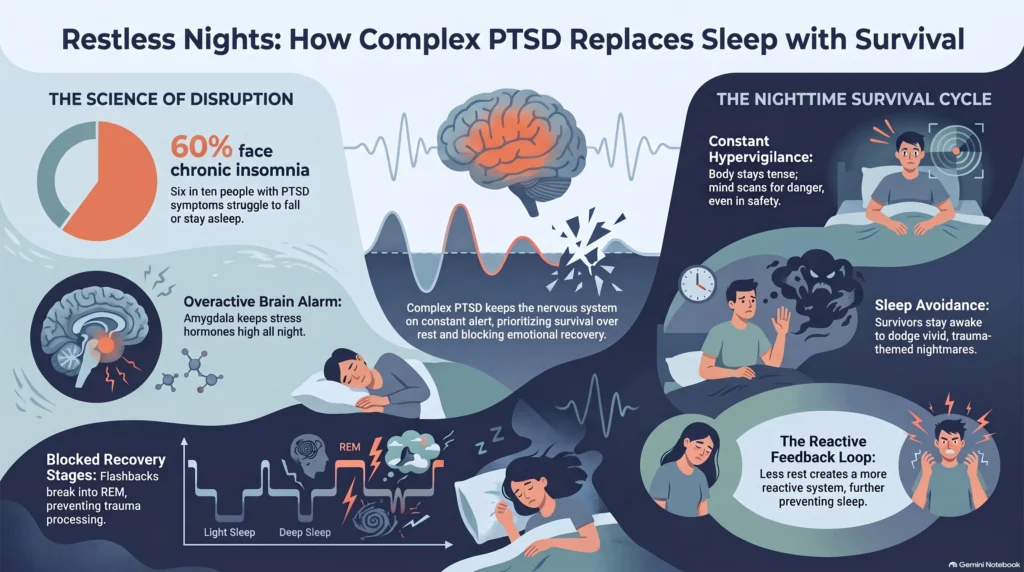
Infographic on how complex PTSD replaces sleep with survival: hypervigilance, overactive brain alarm, blocked REM, sleep avoidance, and a reactive feedback loop.

Why Poor Sleep Makes Complex PTSD Harder to Manage

More than causing tiredness, lost sleep weakens emotional control, hurts focus, and raises the risk of depression and anxiety. Sleep problems are a common reaction to trauma and can make other symptoms feel more intense [3].

Poor sleep and complex PTSD feed each other: less rest means a more reactive nervous system, and a more reactive nervous system means less rest.

Treatment Approaches That Help Trauma-Induced Insomnia

Complex PTSD sleep problems respond to focused care. A therapist can pair trauma treatment with sleep-specific therapy for the best results. Over time, restful sleep can be restored. Lasting change follows from consistent care, not willpower.

  • Trauma-focused therapy: Two options are Cognitive Processing Therapy and Eye Movement Desensitization and Reprocessing. Over time, each of these helps the brain process memories of trauma, calming the alarm system [4].
  • Cognitive Behavioral Therapy for Insomnia (CBT-I): This approach focuses on retraining sleep habits, including calming racing thoughts at bedtime.
  • Imagery Rehearsal Therapy: By rewriting the ending of a repeating nightmare while awake and by practicing the new ending, this technique weakens the nightmare’s power at night.
  • Consistent routines help too: A steady wind-down time, dim light, and a cool room can also help.

Some research studies have combined CBT-I with Imagery Rehearsal Therapy. Together, they led to large drops in insomnia and nightmares. These gains lasted at least six months [5].

In some cases medication can complement trauma-focused therapy when prescribed by a medical professional. For many patients, a blood pressure drug called Prazosin has helped reduce trauma-related nightmares [6].

Do Treatment Programs Include Sleep Therapy?

Some outpatient programs offer weekly sessions. These often run one to two hours and combine trauma work with insomnia-focused techniques. Length and format vary by provider and individual need.

Can Complex PTSD Occur With Other Conditions?

Yes. Often, depression, anxiety, or substance use appear alongside Complex PTSD. Treat these conditions together rather than separately.

How Long Does Treatment Take to Improve Sleep?

Within a few months of starting focused therapy, many people notice improved sleep. Progress varies from person to person, and consistent sessions produce the strongest, most lasting results.
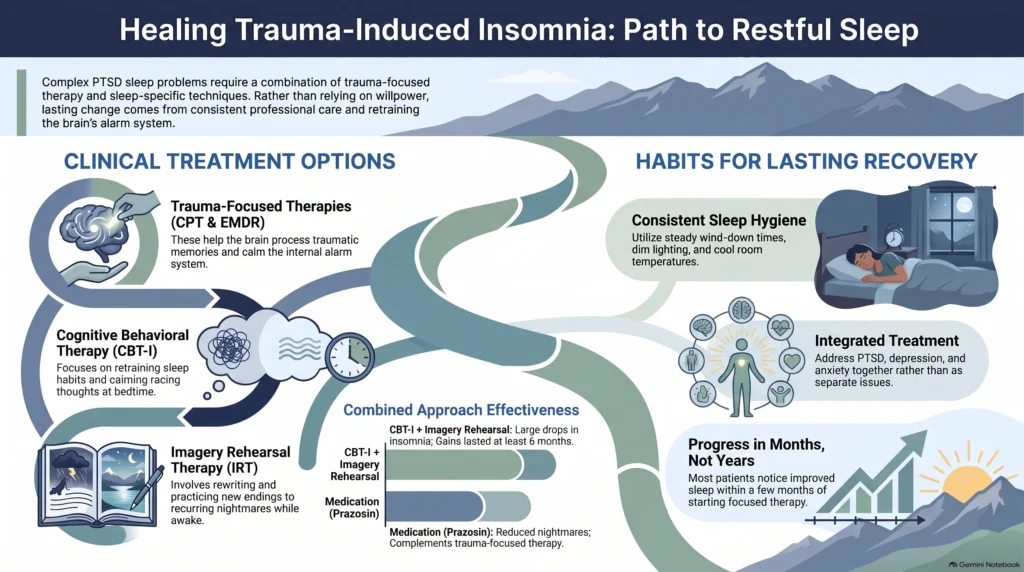
Infographic on healing trauma-induced insomnia: CPT, EMDR, CBT-I, imagery rehearsal, and prazosin plus sleep-hygiene and integrated-treatment habits.

Trauma-focused Treatment in Salt Lake County

Treatment for mental health conditions and trauma is available in Utah. Are you or a loved one looking for a compassionate space to heal from OCD, anxiety, trauma, PTSD, C-PTSD, other mental health conditions, or addictions?

Our licensed trauma-informed therapists and counselors at Corner Canyon Health Centers provide knowledgeable, empathic help using a range of therapeutic and holistic techniques. We also offer ketamine-assisted psychotherapy for treatment-resistant depression.

Reach out to our admissions team at Corner Canyon now. We’re in a peaceful setting bordered by the beautiful Wasatch Mountains.
A person sits on a bench outdoors, using a smartphone. The background is softly blurred, showing trees and people in a park-like setting. In the top left corner, the logo for "Corner Canyon Health Centers" is visible. On the right side, text reads: "PREFER TEXT? Send us a message to receive recovery options via SMS," with a green button below labeled "Text Us Now." The image conveys accessibility and support for mental health services.

Sources

[1]U.S. Department of Veterans Affairs, National Center for PTSD. (2025). Complex PTSD.
[2]U.S. Department of Veterans Affairs, National Center for PTSD. (2026). PTSD and sleep. PTSD Research Quarterly, 37(2).
[3]National Institute of Mental Health. (2024). Traumatic events and post-traumatic stress disorder (PTSD).
[4]U.S. Department of Veterans Affairs, National Center for PTSD. (2025). Overview of psychotherapy for PTSD.
[5]U.S. Department of Veterans Affairs, National Center for PTSD. (2019). Clinician’s Trauma Update (Vol. 13, No. 4).
[6]U.S. Department of Veterans Affairs, National Center for PTSD. (2025). Clinician’s guide to medications for PTSD.

Published on:
Share on:
Popular articles
We Are Here to Help

At Corner Canyon HC, our dedicated healthcare professionals deliver exceptional care and unwavering support. We are committed to providing effective treatment and compassionate assistance for both patients and their families.

Discover the difference in our care today!