
















Traditional antidepressants like SSRIs work slowly on the brain’s serotonin system, often taking four to six weeks to help. Ketamine works on a different system entirely, glutamate, which is why it can lift depression in hours or days instead of weeks.
That single difference in target explains almost everything else: why ketamine acts fast, why it can work when antidepressants have not, and why it is used so differently. Here is how each treatment actually works and who each is suited for.
How Do SSRIs and Other Traditional Antidepressants Actually Work?
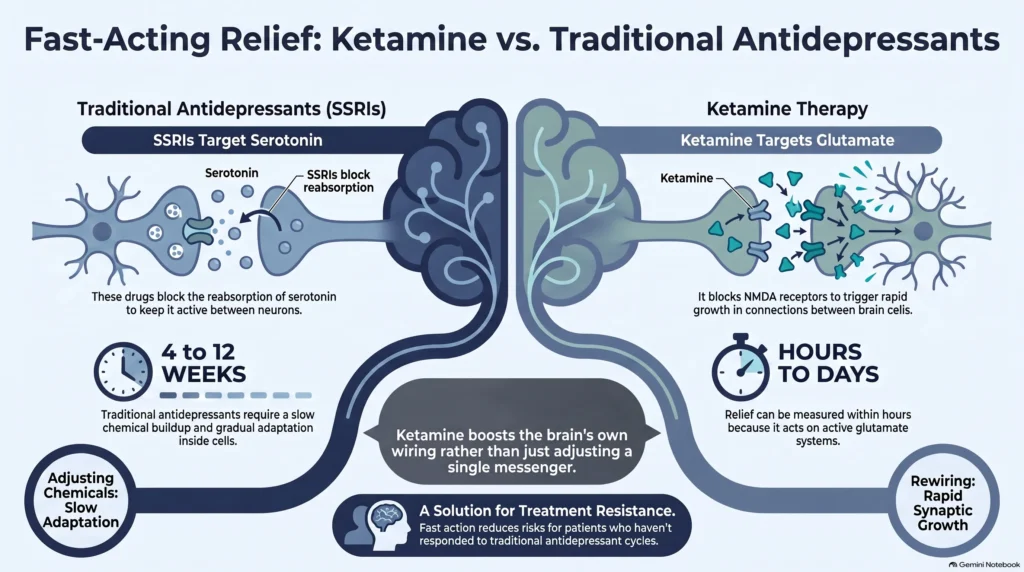
Most traditional antidepressants, including SSRIs such as sertraline and escitalopram, work on the brain’s serotonin system. Normally, brain cells release serotonin and then reabsorb it shortly after. SSRIs block that reabsorption process, called reuptake, so more serotonin stays active in the gaps between neurons for longer [1].
It typically takes four to six weeks at a therapeutic dose before someone feels the full effect, and some people need nine to twelve weeks [1].
Roughly half of people do not respond fully to a first antidepressant, and finding an effective one can mean cycling through several options, each requiring its own weeks-long trial before anyone knows whether it is working [3].
How Does Ketamine Work Differently in the Brain?
Ketamine does not touch the serotonin system directly. One of the most common and growing theories is that it targets a receptor called NMDA, which is part of the brain’s glutamate system, the primary network responsible for fast, everyday brain cell communication. By blocking NMDA receptors, ketamine triggers a cascade that increases activity at another receptor called AMPA, which appears to drive rapid growth in the connections between brain cells [2].
Researchers at the National Institute of Mental Health have described the effect as ketamine essentially boosting the brain’s own wiring, rather than adjusting a single chemical messenger the way SSRIs do [3].
A 2023 review describes ketamine as an open channel blocker of these NMDA receptors and traces how that single action sets off the broader chain of synaptic changes now linked to its antidepressant effect [2].
Why Does Ketamine Work So Much Faster Than Traditional Antidepressants?
Standard antidepressants take weeks because they rely on gradual adaptation inside brain cells. Ketamine can measurably lift depression symptoms within hours of a single dose because it acts directly on the glutamate system that is already active and firing, rather than waiting on a slow chemical buildup [3].
This is precisely why ketamine has drawn so much research interest for severe, treatment-resistant depression, where waiting six weeks to find out if a medication works can carry an increased risk of self-harm, suicidal ideation, or even suicide.
Who Is Ketamine Therapy Actually For?
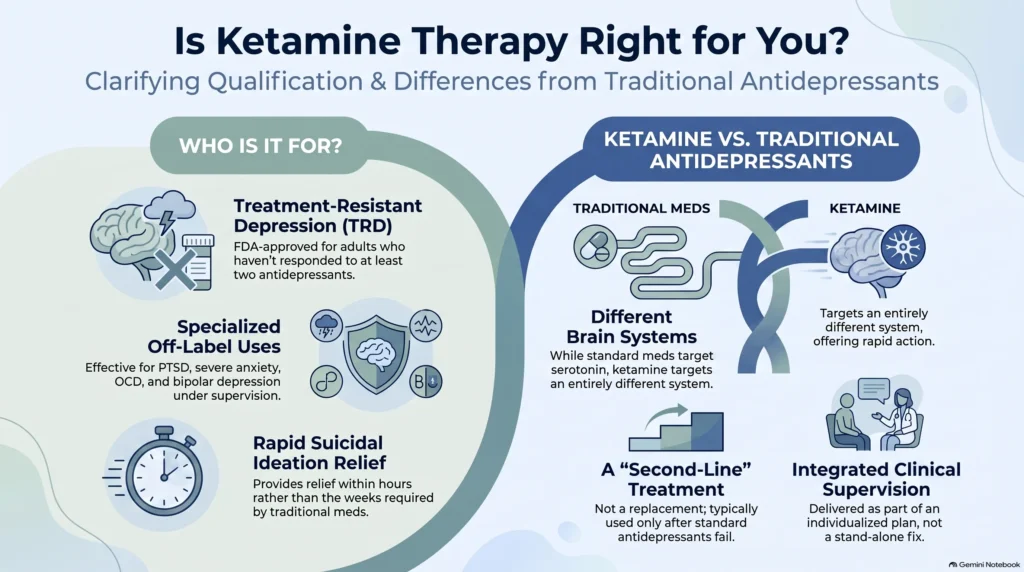
Ketamine and its FDA-approved nasal spray form, esketamine, were approved by the FDA in 2019 specifically for treatment-resistant depression (TRD) in adults. TRD is a form of depression that has not responded to at least two other antidepressants [4].
While treatment-resistant depression is the only use the FDA has formally approved, ketamine is also used off-label by clinicians to treat several other mental health conditions, particularly when standard treatments have not brought enough relief. Research and clinical experience suggest it may help with:
- Post-traumatic stress disorder (PTSD), where it may ease trauma symptoms and support emotional processing
- Severe or treatment-resistant anxiety, when traditional medications have fallen short
- Obsessive-compulsive disorder (OCD), an area of growing research interest
- Bipolar depression, under careful psychiatric supervision
- Acute suicidal ideation, where ketamine’s rapid onset can matter most, since relief can begin in hours rather than the weeks traditional antidepressants require
Is Ketamine a Replacement for Antidepressants?
For most people, no. For most people with depression, antidepressants are still the first treatment doctors recommend. They have a long track record and are simple to take. Ketamine is used differently. It is usually for people who have already tried standard antidepressants without much relief or who need to feel better quickly because their symptoms are severe.
This is also why the difference in how they work matters. Switching from one antidepressant to another keeps you in the same serotonin system, while ketamine targets a different system entirely, which can help when the usual approach has not.
How Corner Canyon Approaches Ketamine Therapy in Utah
Corner Canyon Health Centers offers ketamine therapy as part of a broader, individualized treatment plan, not as a stand-alone quick fix.
Every client’s history with prior medications, the severity of their symptoms, and any co-occurring conditions are considered before ketamine is recommended, and treatment is delivered under close clinical supervision at every step.
Depression treatment is not one-size-fits-all, and knowing how a treatment actually works in the brain is part of making an informed choice. The right option depends on the person, not just the medication.

Sources
[1] Cleveland Clinic. SSRIs (Selective Serotonin Reuptake Inhibitors).
[2] Monteggia, L.M. et al. Ketamine and Rapid Antidepressant Action: New Treatments and Novel Synaptic Signaling Mechanisms. Neuropsychopharmacology.
[3] National Institute of Mental Health. Rapidly-Acting Treatments for Treatment-Resistant Depression (RAPID).
[4] U.S. Food and Drug Administration. FDA Approves New Nasal Spray Medication for Treatment-Resistant Depression.