
















Disturbing nightmares are one of the most common symptoms of Complex PTSD (CPTSD), caused by repeated or prolonged trauma.
These dreams replay fear and threat during sleep. Understanding why they happen helps you treat them, protect your sleep, and loosen their grip on daily life.
How Is Complex PTSD Different From PTSD?
Ordinary PTSD often follows a single frightening event, such as a car crash or an assault. CPTSD develops from trauma that repeats over months or years and that a person cannot escape, such as childhood abuse, neglect, domestic violence, or captivity.
CPTSD includes the core symptoms of PTSD, such as reliving the trauma, avoiding reminders, and feeling constant threat. On top of these, it adds three further problems [1]:
- Trouble regulating emotion
- A harsh and negative self-image
- Difficulty trusting or staying close to other people
Because the danger was ongoing, the nervous system learned to stay braced for harm around the clock, and that state did not switch off at bedtime.
Why Does Complex PTSD Cause Disturbing Dreams?
Nightmares are a hallmark symptom of trauma [2]. In one large study of more than 4,000 trauma-exposed young people, the odds of clinically significant nightmares rose about 1.3 times with each added type of trauma a child had experienced [2].
Because CPTSD grows out of repeated and layered trauma, the sleeping brain carries an unusually heavy load of frightening memories to process.
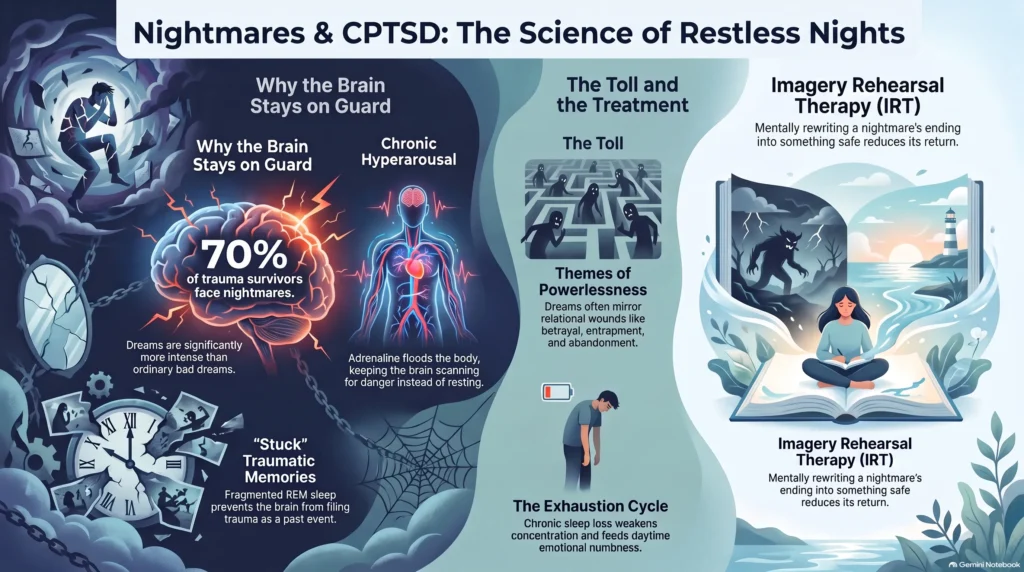
Trauma also keeps the body in a state of hyperarousal. The stress response that once helped a person survive stays switched on, flooding the body with adrenaline and keeping the brain scanning for danger instead of settling into rest. REM sleep, the stage where most vivid dreaming occurs, is fragmented by this overactivity [3].
Disrupted REM also weakens the brain’s ability to file traumatic memories as finished, past events. Instead of fading, the memory keeps its emotional charge and resurfaces at night as a present threat [3].
Broken sleep then brings little rest and instead feels closer to the original danger, so the body braces even harder the next night, and the cycle repeats.
What Types of Nightmares Does CPTSD Cause?
Trauma-related nightmares affect up to 70% of people with PTSD, often with far greater intensity than ordinary bad dreams [4]. In CPTSD, the dreams tend to mirror the relational wounds behind the disorder, so themes of betrayal, powerlessness, and shame appear again and again.
The examples below show the forms these dreams most often take and how each one tends to land the next day.
- Literal replays re-enact the trauma almost exactly, scene by scene, such as reliving an assault or a childhood beating in real time. People often wake in panic, drenched in sweat with a racing heart, and may need several minutes to tell the dream apart from a real event.
- Distorted or symbolic dreams show the threat in an altered form. Examples include drowning, being buried, a house collapsing, or a faceless figure closing in. Although the events are not literally what happened, the terror and helplessness feel exactly the same.
- Pursuit and entrapment dreams leave the dreamer chased, cornered, or frozen and unable to move or call for help. The deep sense of powerlessness that CPTSD already carries is reinforced in these dreams. It can leave a person on edge long after waking.
- Betrayal and abandonment dreams turn trusted people hostile or show loved ones leaving without warning. They are especially common after relational trauma. Often triggering shame, guilt, or worthlessness upon waking, they feed the negative self-image at the center of CPTSD.
- Recurring loop nightmares return the same dream night after night with little change. Over time, the repetition breeds a fear of falling asleep at all, pushing people to delay bedtime and worsening insomnia.
How Do Trauma Nightmares Affect Daily Life?
The damage does not stay in the bedroom. Sleep is fragmented by repeated nightmares causing chronic sleep loss. This weakens concentration, memory, and emotional control the following day [5].
Exhaustion is deepened when people begin to fear sleep itself and put off going to bed, leaving them feeling drained. The lack of sleep feeds daytime symptoms of CPTSD, including irritability, emotional numbness, trouble focusing at work, and a low sense of self-worth.
A short fuse and constant tiredness make relationships suffer too, straining patience with partners, children, and coworkers.
The stakes can be higher still. Trauma-related nightmares are linked to greater suicide risk, partly through the feelings of defeat, entrapment, and hopelessness that the dreams reinforce night after night [4].
For that reason, clinicians treat persistent nightmares as a symptom worth addressing directly, not one to wait out. If nightmares are disrupting sleep several nights a week, it is important to seek professional support rather than trying to cope alone.
How Are Complex PTSD Nightmares Treated?
Trauma nightmares respond well to treatment, so they are rarely something a person has to simply endure [5]. Imagery rehearsal therapy is one of the most studied approaches. A person recalls a recurring nightmare while awake, rewrites its ending into something safer or more neutral, and then mentally rehearses the new version for a few minutes each day.
Over time, this practice reduces how often the original nightmare returns and how distressing it feels [6]. For someone who repeatedly dreams of being chased, for example, the rewritten version might have them turn, find help, and reach safety.
Other approaches can work alongside it. Trauma-focused therapies such as Cognitive Behavioral Therapy (CBT) and Eye Movement Desensitization and Reprocessing (EMDR) help the brain process the underlying memories so they carry less charge at night. Steadier sleep habits, a calming wind-down routine, and grounding techniques for the moments after waking can all lower the intensity of nightmares.
In some cases a doctor may prescribe medication to reduce the frequency of nightmares [6]. Recovery rarely follows a straight line, but working with a trauma-informed clinician offers the most reliable path to calmer nights.
Frequently Asked Questions
Can complex PTSD nightmares go away?
Yes. With trauma-focused therapy and approaches such as imagery rehearsal therapy, many people find their nightmares become less frequent and less intense over time [6].
Are CPTSD nightmares different from ordinary bad dreams?
Often, yes. They tend to be more vivid, more repetitive, and more closely tied to real events, and they disturb sleep far more than typical bad dreams [4].
How can I calm down after a trauma nightmare?
Simple grounding helps. Sit up, breathe slowly, name a few things you can see and touch, and remind yourself that the danger is in the past. Over the longer term, working with a therapist on the underlying trauma reduces how often the nightmares return [6].
Trauma-Focused Treatment in Salt Lake County
Treatment for mental health conditions and trauma is available at our center in Utah, in a peaceful setting bordered by the beautiful Wasatch Mountains. Are you or a loved one looking for a compassionate space to heal from OCD, anxiety, trauma, PTSD, C-PTSD, other mental health conditions, or addictions? Corner Canyon accepts Select Health insurance billed as out-of-network.
Our licensed trauma-informed therapists and counselors at Corner Canyon Health Centers provide knowledgeable, empathic help using a range of therapeutic and holistic techniques. We also offer ketamine-assisted psychotherapy for treatment-resistant depression.
Reach out to our admissions team at Corner Canyon now.

Sources
| [1] | Maercker, A. (2021). Development of the new CPTSD diagnosis for ICD-11. Borderline Personality Disorder and Emotion Dysregulation, 8, 7. |
| [2] | Secrist, M. E., et al. (2019). Nightmares in treatment-seeking youth: The role of cumulative trauma exposure. Journal of Child & Adolescent Trauma, 13(2), 249–256. |
| [3] | Lancel, M., et al. (2021). Disturbed sleep in PTSD: Thinking beyond nightmares. Frontiers in Psychiatry, 12, 767760. |
| [4] | Weber, F. C., et al. (2020). Sleep disturbances and suicidality in posttraumatic stress disorder: An overview of the literature. Frontiers in Psychiatry, 11, 167. |
| [5] | Haeyen, S., & Staal, M. (2021). Imagery rehearsal based art therapy: Treatment of post-traumatic nightmares in art therapy. Frontiers in Psychology, 11, 628717. |
| [6] | Sahu, N., et al. (2024). Understanding and treating nightmares: A comprehensive review of psychosocial strategies for adults and children. Cureus, 16(9), e70044. |