















Gender dysphoria is a clinical diagnosis: the distress caused by a mismatch between a person’s gender identity and their sex assigned at birth. It is not the same thing as being transgender.
For adults, treatment is individualized and falls into four possible categories: social, legal, medical, and surgical affirmation. No one must pursue all of them, and two people with the same diagnosis can have very different plans.
Here is what the diagnosis actually means, what the established guidelines say, and why mental health support matters at every step.
What Is Gender Dysphoria?
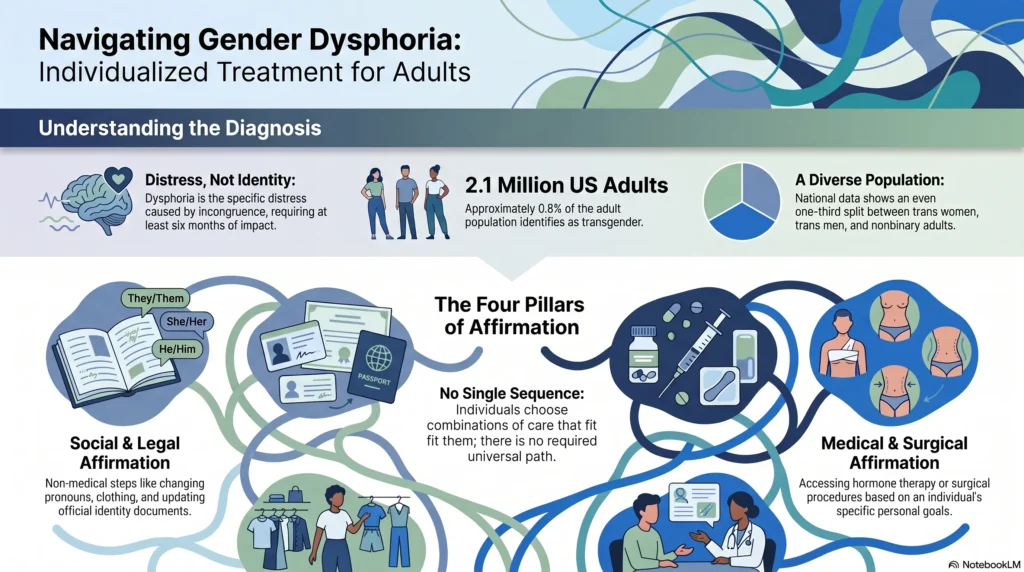
Gender dysphoria is a diagnosis defined by the American Psychiatric Association as clinically significant distress or impairment resulting from an incongruence between a person’s experienced gender and the sex they were assigned at birth.
It is important to note that being transgender itself is not a psychiatric diagnosis. Gender dysphoria specifically refers to the distress some, though not all, transgender people experience, and the diagnosis requires that this distress last at least six months and meaningfully affect a person’s social, occupational, or personal functioning [1].
Some people experience this distress from an early age, while others do not recognize or name it until after puberty, or even much later in adulthood, which is part of why an accurate evaluation matters more than a person’s age at the time they seek care [1].
How Many Adults Experience This?
Based on the most recent analysis of national health survey data, approximately 2.1 million adults in the United States, or about 0.8% of the adult population, identify as transgender. Among these adults, roughly one-third identify as trans women, one-third as trans men, and one-third as nonbinary [3].
Not every transgender adult experiences clinical gender dysphoria, since distress is not universal, but the population of adults who may seek an evaluation or treatment is not small or rare.
What Treatment Options Actually Exist for Adults?
Care for adults with gender dysphoria typically falls into a few distinct categories as described by the American Psychiatric Association. Not everyone pursues all of them [1].
The four categories the APA describes are:
Social affirmation: Living in alignment with one’s gender identity through things like name, pronouns, hairstyle, or clothing. This involves no medical steps.
Legal affirmation: Updating identity documents, such as changing the name or gender marker on a driver’s license, passport, or other records.
Medical affirmation: Medical care such as hormone therapy, pursued with a provider based on the individual’s goals.
Surgical affirmation: A range of possible procedures, which some people choose and many do not, depending on what they are seeking.
These are treated as separate, personal decisions rather than a single required sequence, and a person can pursue any combination based on their own goals. There is no single, universal version of this process.
Two adults with the same diagnosis may end up with entirely different treatment plans, and that is considered appropriate rather than inconsistent, since the goal is matching care to the individual rather than applying one template to everyone.
How Do Hormone Therapy and Surgery Actually Work for Adults?
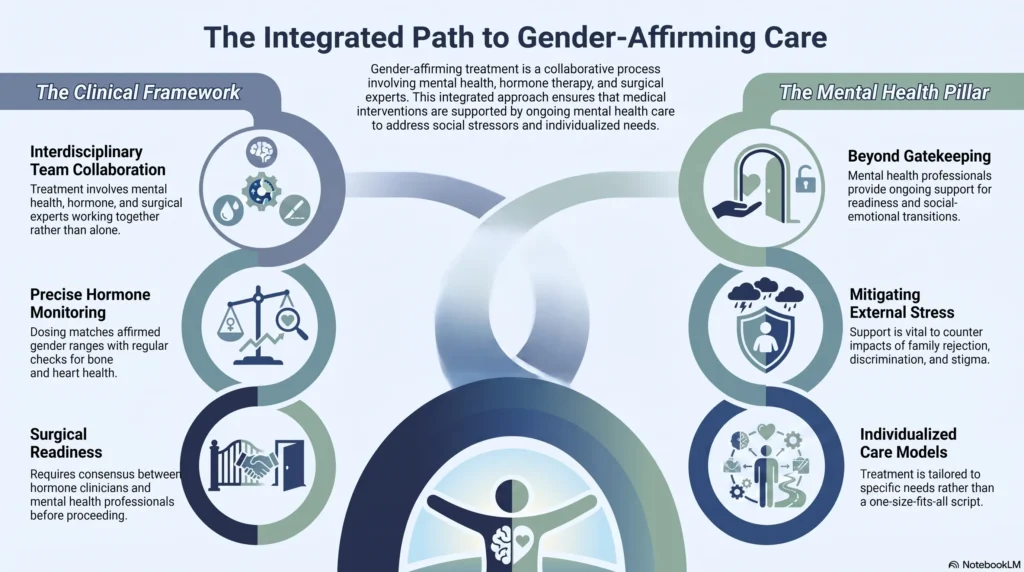
For adults who pursue medical treatment, the Endocrine Society’s clinical practice guideline recommends a treatment team with expertise across mental health, hormone therapy, and, where relevant, surgery, working together, rather than a single provider acting alone [2].
Hormone therapy is dosed to bring sex steroid levels into the typical range for a person’s affirmed gender, with regular monitoring for bone health, cardiovascular risk, and other factors throughout treatment [2].
Surgical options, when pursued, are recommended only after a clinician overseeing hormone treatment and a mental health professional agree that surgery is medically appropriate for that individual [4].
Why Does Mental Health Support Matter Throughout the Process?
Mental health care is not a gatekeeping formality; it is a genuine part of effective treatment.
Both the Endocrine Society and the American Psychiatric Association note that a qualified mental health professional plays an ongoing role, not just at the start of treatment but throughout it, helping assess readiness, address co-occurring conditions, and support a person through the social and emotional realities of transition [1][2].
This matters because family rejection, discrimination, and social stigma are strongly linked to worse mental health outcomes for transgender adults, which makes consistent, informed support important [1].
How Does Corner Canyon Support Adults Through This Process?
Corner Canyon Health Centers works with transgender and gender-diverse adults throughout the entire process, not just at a single decision point. Staff are trained specifically in the realities of gender dysphoria and the broader mental health needs that often accompany it, so a client does not have to educate their own care team before receiving actual care.
Whether someone is exploring their options, already receiving hormone therapy, or working through the mental health impact of family or social rejection, mental health treatment is built around the individual rather than a one-size-fits-all script.
Gender dysphoria treatment is not a single path, and it is not guesswork either. It is a set of well-documented, individualized options, and getting accurate information is the first real step toward the right one. Contact our admissions team today.

Sources
[1] American Psychiatric Association. What Is Gender Dysphoria?
[2] Hembree, W.C. et al. Endocrine Treatment of Gender-Dysphoric/Gender-Incongruent Persons: An Endocrine Society Clinical Practice Guideline.
[3] Williams Institute. How Many Adults and Youth Identify as Transgender in the United States?
[4] World Professional Association for Transgender Health. Standards of Care for the Health of Transgender and Gender Diverse People, Version 8.