












⚠️ We Do Not Accept Medicare or Medicaid 

How To Know If You Need Inpatient Mental Health Treatment

Cheryl Kehl, LCSW, SGB, MTHFR

Founder

Cheryl has been working in the Mental Health and Addiction treatment industry since 1991, as a clinician, clinical director, program founder, program administrator, and facility decorator! In 1998 she co-founded Second Nature Wilderness Program for adolescents, after working for a competitor for 5 years.

Based on her concerns about some aspects of outdoor therapy, she created a safer and more clinically sound model. These changes made the treatment experience more accessible to a broader adolescent population and helped parents feel more comfortable about sending their children to do therapy in the outdoors.

Wilderness therapy is the most impactful treatment that an adolescent or young adult can experience, and she brought many of those treatment modalities into the clinical model at Corner Canyon. She was involved in founding two adolescent residential treatment programs. There she gained valuable experience that later provided a foundation for starting Corner Canyon, the result of these experiences, her education, and her own experiences in treatment.

During her treatment, Cheryl identified impactful elements, barriers to clinical growth, and ways to ensure clients feel comfortable and cared for during the challenges of residential care.

Corner Canyon’s focus on comprehensive and innovative assessment, advanced and validated clinical practices, and implementation of the most effective new technologies and research, are due to her desire to help others gain full health quickly and effectively in a comfortable setting.

Cheryl completed her education at Brigham Young University, where she received her Bachelor of Science in Psychology and Sociology in 1991 and, in 1993, her Master’s Degree in Social Work. She pursues interests in science, technology, and mental and physical health, and is fascinated by the intersection of these with the ability to help clients heal faster.

Cheryl is the oldest of ten children and has three adult children, two daughters and a son. Her interests include water sports, photography, interior design, creative projects, and spending time with her family and friends. She loves house boating on Lake Powell, but her favorite pastime is spending time with her 6 wonderful grandchildren.

Cheryl Kehl, LCSW, SGB, MTHFR

Founder

Cheryl has been working in the Mental Health and Addiction treatment industry since 1991, as a clinician, clinical director, program founder, program administrator, and facility decorator! In 1998 she co-founded Second Nature Wilderness Program for adolescents, after working for a competitor for 5 years.

Based on her concerns about some aspects of outdoor therapy, she created a safer and more clinically sound model. These changes made the treatment experience more accessible to a broader adolescent population and helped parents feel more comfortable about sending their children to do therapy in the outdoors.

Wilderness therapy is the most impactful treatment that an adolescent or young adult can experience, and she brought many of those treatment modalities into the clinical model at Corner Canyon. She was involved in founding two adolescent residential treatment programs. There she gained valuable experience that later provided a foundation for starting Corner Canyon, the result of these experiences, her education, and her own experiences in treatment.

During her treatment, Cheryl identified impactful elements, barriers to clinical growth, and ways to ensure clients feel comfortable and cared for during the challenges of residential care.

Corner Canyon’s focus on comprehensive and innovative assessment, advanced and validated clinical practices, and implementation of the most effective new technologies and research, are due to her desire to help others gain full health quickly and effectively in a comfortable setting.

Cheryl completed her education at Brigham Young University, where she received her Bachelor of Science in Psychology and Sociology in 1991 and, in 1993, her Master’s Degree in Social Work. She pursues interests in science, technology, and mental and physical health, and is fascinated by the intersection of these with the ability to help clients heal faster.

Cheryl is the oldest of ten children and has three adult children, two daughters and a son. Her interests include water sports, photography, interior design, creative projects, and spending time with her family and friends. She loves house boating on Lake Powell, but her favorite pastime is spending time with her 6 wonderful grandchildren.

Published on:
Share on:
Table of Contents

Latest/Popular Blogs

We work with most major insurance policies

Corner Canyon now accepts most major health insurance plans. Get in touch with our admissions team today.

If you or a loved one is experiencing mental health symptoms that feel overwhelming or are unsafe to manage alone, inpatient care with 24/7 support can be the most appropriate alternative.

Within this structured environment, you will have continuous access to care, including medication management, counseling, and daily therapeutic support designed to help you stabilize and prepare to move forward.

Yoga, meditation, and other wellness activities are offered, together with healthy nutrition choices, to help you restore balance and begin your recovery journey.

Whether it be in hospital-based inpatient stays, a residential program, or an intensive partial hospitalization program, you or a loved one can access the right support at the right time by understanding the difference between these levels of care.

What Inpatient Mental Health Treatment Means

Mental health treatment exists on a continuum of intensity. Residential treatment is among the most intense. It involves living at a facility for weeks to months while receiving round-the-clock therapeutic support and taking advantage of the various amenities that may be available.

Hospital-based inpatient care is among the most intensive levels and is designed for people in acute psychiatric crisis who require 24-hour monitoring and stabilization [1].

Most admissions are voluntary. Involuntary hospitalization requires a clinician’s determination that a person presents an imminent danger to themselves or others and is refusing care. Criteria and hold duration are governed by state law.
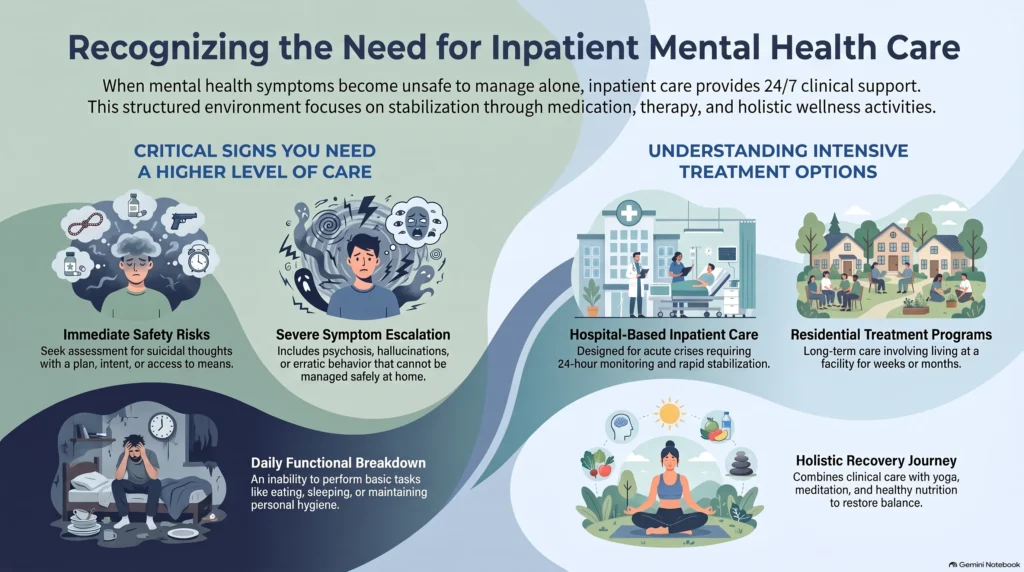
Infographic titled Recognizing the Need for Inpatient Mental Health Care, listing critical signs of needing a higher level of care, including immediate safety risks, severe symptom escalation such as psychosis, and daily functional breakdown, alongside intensive treatment options: hospital-based inpatient care, residential treatment programs, and a holistic recovery journey combining clinical care with yoga, meditation, and nutrition.

Signs You May Need a Higher Level of Care

In 2022, an estimated 15.4 million U.S. adults lived with serious mental illness, yet more than one-third received no treatment that year [2]. Delayed care can increase risk for those with severe symptoms.

If the following signs are present, a higher level of care is needed, but a psychiatrist must confirm this:

  • Immediate clinical assessment is required when there are suicidal thoughts with a plan, intent, or access to means [3].

  • For symptoms of psychosis such as hallucinations, delusions, or disorganized thinking, 24-hour monitoring and medication management are usually required [4].

  • An inability to carry out basic daily tasks such as eating, sleeping, or maintaining personal hygiene signals serious functional breakdown.

  • If symptoms have not improved after a reasonable trial period of outpatient therapy or medication, then a more intense level of care may be necessary.

  • Severe mood episodes may cause dangerous or erratic behavior that cannot be managed safely at home.

  • Self-harm behaviors are increasing in frequency or severity, despite current outpatient support.

  • There is no safe or stable home environment available to support recovery.

How Clinicians Assess the Need for Inpatient Care

To assess your best level of care, clinicians review your medical history, current medications, and response to prior treatment [5]. They assess any risk of suicide and the patient’s available social support [6] This assessment results in a recommended level of care and a treatment plan.

Clinicians typically place people at greatest risk in hospital-based inpatient care for acute stabilization. Those with severe but subacute conditions are often appropriate for residential treatment or a Partial Hospitalization Program (PHP). The aim is always to match the intensity of care to the clinical severity of the person’s condition.

What Residential and PHP Treatment Involves

Residential and PHP programs typically combine individual therapy, group therapy, psychiatric evaluation, and medication management. Holistic approaches such as nutrition counseling, yoga, equine therapy, and adventure-based activities are offered by the best programs.

Programs serving LGBTQ+ adults may offer gender-affirming care and community-specific housing arrangements. The best programs address co-occurring diagnoses, including trauma, mood disorders, and anxiety disorders, within a single continuum of care.

The goal of a higher level of care is not only symptom stabilization. Programs help people build the coping skills and support structures needed to step down safely to IOP, outpatient therapy, or community-based care. Discharge planning, including for continuing care, typically begins on or shortly after admission.
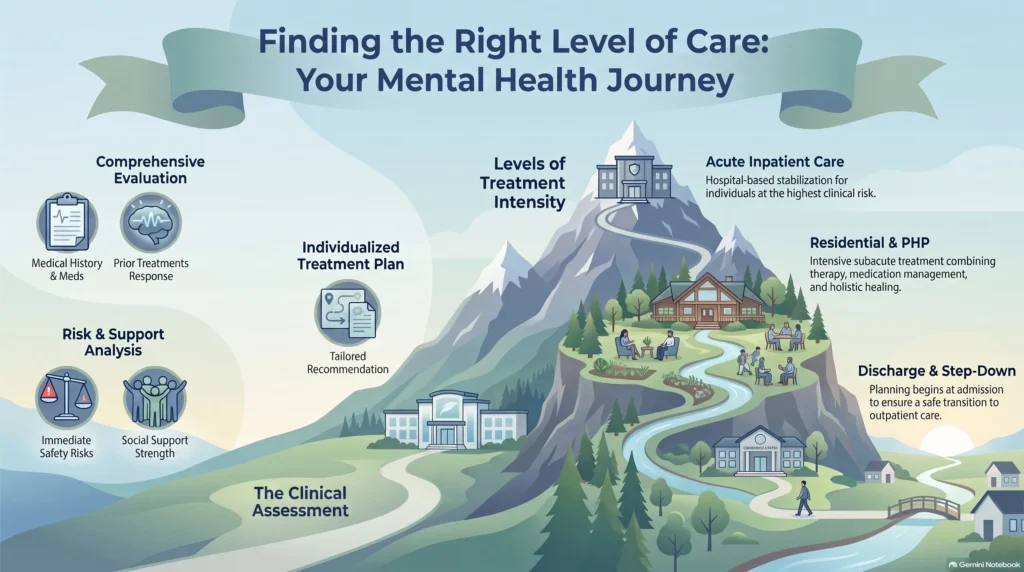
Infographic titled Finding the Right Level of Care: Your Mental Health Journey, showing a clinical assessment path with comprehensive evaluation of medical history and prior treatment response, risk and support analysis, and an individualized treatment plan, leading up a mountain through levels of treatment intensity: residential and PHP, acute hospital-based inpatient care, and discharge and step-down planning.

Trauma-focused Treatment in Salt Lake County

Treatment for mental health conditions and trauma is available in Utah. Are you or a loved one looking for a compassionate space to heal from OCD, anxiety, trauma, PTSD, C-PTSD, other mental health conditions, or addictions?

Our licensed trauma-informed therapists and counselors at Corner Canyon Health Centers provide knowledgeable, empathic help using a range of therapeutic and holistic techniques. We also offer ketamine-assisted psychotherapy for treatment-resistant depression.

Reach out to our admissions team at Corner Canyon now. We’re in a peaceful setting bordered by the beautiful Wasatch Mountains.

Background image of a narrow canyon with text overlay reading: “QUESTIONS? Call or Text us 24/7 for more info.” Includes the Corner Canyon Health Centers logo and a green button labeled “Call Us Now.”

Sources

[1]Substance Abuse and Mental Health Services Administration. (2023). Treatment types for mental health, drugs and alcohol. SAMHSA.
[2]National Institute of Mental Health. (2024). Mental illness. National Institute of Mental Health.
[3]Weber, A. N. et al. (2017). Psychiatric emergencies: Assessing and managing suicidal ideation. Medical Clinics of North America, 101(3), 553–571.
[4]Yee, A. et al. (2024). Hospitalization and help-seeking among first episode psychosis patients. Discover Mental Health, 4(1), 10.
[5]Sarkhel, S. et al. (2023). Clinical practice guidelines for management of suicidal behaviour. Indian Journal of Psychiatry, 65(2), 124–130.
[6]Chammas, F. et al. (2022). Inpatient suicide in psychiatric settings: Evaluation of current prevention measures. Frontiers in Psychiatry, 13, 997
Published on:
Share on:
Popular articles
We Are Here to Help

At Corner Canyon HC, our dedicated healthcare professionals deliver exceptional care and unwavering support. We are committed to providing effective treatment and compassionate assistance for both patients and their families.

Discover the difference in our care today!