















Holistic mental health treatment means treating the whole person—mind, body, relationships, and environment—rather than targeting symptoms in isolation. It is not an alternative to clinical care, and it is not a replacement for therapy or medication.
Done correctly, it means evidence-based treatment like therapy and psychiatric care working alongside things like nutrition, movement, sleep, and community support, because those factors measurably affect mental health outcomes.
Here is what that looks like in practice and how it works at Corner Canyon Health Centers.
What Does Holistic Mental Health Treatment Actually Mean?
The National Center for Complementary and Integrative Health defines whole person health as looking at a person’s biological, behavioral, social, and environmental factors together, rather than treating a single diagnosis in isolation.
This approach focuses on restoring health and building resilience across a person’s life, not just addressing one set of symptoms in a single appointment [1].
In practice, this means combining conventional treatment, such as therapy and medication management, with complementary approaches like movement, nutrition, and mindfulness, since real health rarely comes from a single intervention working alone [1].
Why Combine Holistic Care with Clinical Treatment at All?
Because mental health does not exist in isolation from the rest of a person’s life. Chronic stress, poor sleep, and disconnection from one’s body and community are all factors that matter. Addressing only one piece of that picture tends to worsen depression, anxiety, and trauma symptoms and produce incomplete results [1].
Whole person models, including the approach used by the U.S. Department of Veterans Affairs, pair standard medical and psychiatric treatment with practices like movement, nutrition, and stress management specifically because the two approaches address different parts of the same problem [1].
Holistic care is not a replacement for evidence-based therapy; it is what makes that therapy effective once someone leaves a session. A person can make real progress in a fifty-minute session and still struggle the moment they are back in a stressful environment without any tools for managing their body’s response to it. Holistic practices give clients something to actually use in that gap.
What Holistic Activities Does Corner Canyon Offer?
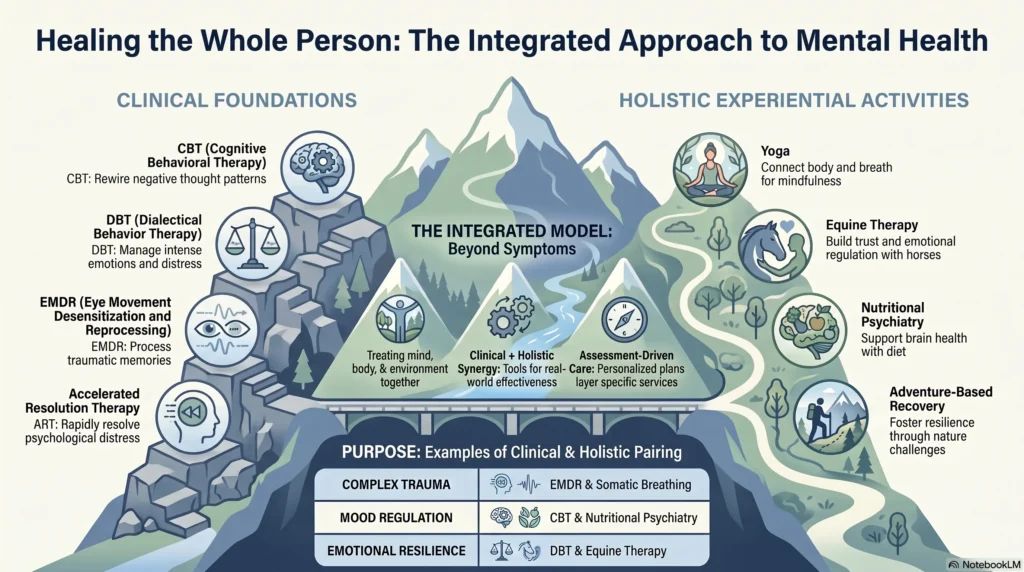
Corner Canyon complements its clinical therapies, including CBT, DBT, EMDR, and Accelerated Resolution Therapy, with a full range of holistic and experiential activities, including:
- Trauma-informed yoga and somatic breathing help clients reconnect with physical sensation and reduce the nervous system activation that often accompanies trauma and anxiety [2].
- Nutritional psychiatry and the Gut-Brain Diet, developed with an on-staff nutritionist, are based on the growing body of research linking gut health to mood and cognitive function [2].
- Massage therapy supports physical relaxation and nervous system regulation alongside talk therapy [2].
- Music therapy and mindfulness meditation give clients tools for emotional regulation that extend beyond the length of a single therapy session [3].
- Adventure therapy combines nature, community, and exercises during the recovery process. It includes hiking and time spent exploring the beautiful Wasatch Mountains, as well as snowboarding and skiing in winter, which support both physical health and a sense of connection during treatment [3].
- Equine Therapy: Equine therapy promotes emotional healing, personal growth, and resilience. Because horses respond authentically to human emotions, they serve as unique therapeutic partners.
- Sober softball
- Ropes courses
- Swimming together in the PHP/transitional living house pool
- Team-building exercises
- Service projects
How Does Holistic Care Actually Fit into a Treatment Plan?
None of these activities are assigned at random. Corner Canyon’s clinical model starts with a comprehensive assessment, including psychological, psychiatric, and health evaluations, and holistic services are layered into a client’s plan based on what that assessment actually shows [2].
A client working through complex trauma might be paired with equine therapy and somatic work alongside EMDR, while someone focused on mood regulation might spend more time with nutritional psychiatry and mindfulness. The goal is not to offer every service to every patient, but to match the right combination of clinical and holistic care to the person in front of the treatment team.
Holistic Mental Health Treatment in Utah’s Mountain Landscape
Corner Canyon’s residential programs sit at the foot of the Wasatch Mountains in Draper, Utah, which is not just a scenic detail.
Access to nature, outdoor space, and a home-based residential setting rather than an institutional one all support the kind of nervous system regulation that holistic therapies are designed to build [3]. Clients are not just learning skills in a clinical office; they are practicing them in an environment built to reinforce recovery rather than work against it.
Small, home-based residential settings, rather than a large institutional facility, also make it easier for staff to notice when a client needs extra support and adjust their plan quickly instead of waiting for a scheduled check-in.
Holistic mental health treatment is not an alternative to real clinical care; it is what makes clinical care last. At Corner Canyon, the two are built together from the first assessment, not bolted on as an afterthought, because lasting change usually depends on treating the whole person, not just a diagnosis.

Sources
[1] National Center for Complementary and Integrative Health. Whole Person Health: What It Is and Why It’s Important.
[2] Corner Canyon Health Centers. About Our Mental Health Center in Draper, UT.
[3] Recovery.com. Corner Canyon Health Centers: Verified Pricing, Reviews & Testimonials.